Making this book let me look at and combine all the different creative sides of myself.
Jenny Walton
Jenny Walton is color before she is anything else, an artist, illustrator, writer, designer, Vogue vintage shopping columnist. Known for her illustrations, alive with color, and she collects Prada the way other people collect first editions: patiently, with an eye (and ear) for the story each piece carries.
Her debut book, Jenny Sais Quoi: Adventures in Vintage & Personal Style (Monacelli/Phaidon, 2026), is part scrapbook, part sketchbook, part sartorial manifesto. Completely illustrated and photographed by her and assembled together as artful collage and playful trompe-l’oeil. The result is a visual diary that is uniquely a “the messy, magical world of self-expression.”
Having grown up in South Jersey, surrounded by cornfields and yard sales, raised by a mother who quilted and a father who watched Project Runway with her on weeknight evenings. She learned to sew before she learned to sketch, and learned to sketch before she learned that the two would become her life.
Jenny studied fashion design at Parsons, and captivated an audience during the early days of Instagram with her subway drawings an hour each way. Those quick sketches ended up changing the shape of her career.
Years followed, where she arrived in Milan alone, after a love story had ended. She stayed and found an apartment with parquet floors from 1920 and two stone lions at the entrance. Filling it slowly, the way she fills a wardrobe: a Gio Ponti piece here and a provincial French corner chair there but with all soulful pieces. Jenny embraced the language, learning Italian and practicing at her neighborhood bar. While her eye has been shaped by the city’s light and its delightful unhurried relationship to beauty has transposed into her dreamy watercolor with beautiful hand-lettering.
Speaking with Jenny was a particular delight. Hers is a voice you recognize before you can quite describe it, one that turns even the smallest detail into something that feels like a secret worth keeping. What follows is our conversation.
Rowena Lei: There is something vulnerable about making a book with no distance between maker and subject. You illustrated, photographed, and collaged every page yourself, down to the hand-lettered cover. What was it like to sit that close to yourself for so long?
Jenny Walton: It was the first time I’ve worked on a single project and object for that long. Before creating this book, the longest creative projects I did were creating oil paintings, which can take weeks and sometimes months. Making this book let me look at and combine all the different creative sides of myself. Sometimes, I think we can get down on ourselves for having too many varied interests, not honing in on just one thing. So it was so satisfying to combine my various talents (painting, writing, illustrating, art direction, creating layouts, collage, etc.) into one object.
Rowena Lei: As an artist, you are most likely familiar with the way a painted-over canvas sometimes shows through the surface. You spent a year in conversation with your editor, circling all the possible shapes the book could take before it settled into this one. When you look back now, can you still see some of the versions you discarded alive inside the final thing? And does the same happen with your personal style, earlier selves visible beneath what you wear today?
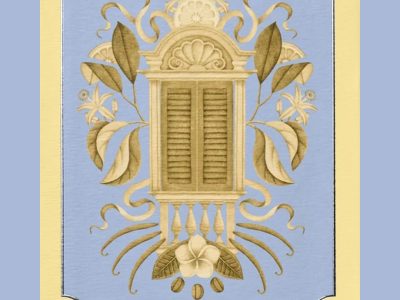
Jenny Walton: Yes absolutely. There are some layouts that were in the initial pitch and others which came together in the final days and are still some of my favorites. Even the yellowed edging on the cover is a leftover layer from when the book cover was originally a mango color instead of the vintage blue flower fabric. I think great style is built slowly overtime on all of the past layers of oneself. That’s what makes great style so rich.
RL: We would love to learn a bit about your process, the way you write about color palettes feels almost musical: the warmth of the “sherbet family,” the tension between red and blue. When deciding on a palette for an outfit or a page in the book, does it begin with a feeling, with a memory, or with something you notice in the room around you?
JW: Every process I try to make as organic as possible. So I grab one thing that I’m really drawn to, which could be a vintage yellow floral printed dress, and then I build off of that, and it becomes a game of layering. So maybe I add a straw bag, or a gold sandal. For the book, I have folders on my phone with tens of thousands of images I’ve taken over the years of special little moments. My editor and I played a mix-and-match game, combining photos into stories. We actively tried to pair a fashion color-paletting moment with something architectural or environmental, to illustrate how this way of seeing your wardrobe also relates to the world.
RL: The world you illustrate is the world you inhabit: terrazzo floors, espresso cups, the Milanese sciure. The drawings are loose, gestural, quick, as though catching something before it escapes. There is an interesting juxtaposition there, what do you think is the relationship between the speed of your line and the slowness of the life you live?
JW: It’s all instinctual I think. I am drawn to beautiful, thoughtful things and I do love simplicity. So much of Sciura style is simplistic (at least the really good sciura style anyway). I’m also not afraid of taking bold risks. I moved to Italy, to California, to New York when I was 18. I go with my gut and I love new adventures. I love exploring new places.
RL: You have spoken of “10,000 Hours of Style,” the same principles Malcolm Gladwell talks about in his book about mastery. But mastery usually implies arriving somewhere. Do you believe style has a destination, or is it more like a walk towards no fixed address?
JW: Style never ends because it’s always evolving. But with 10,000 hours of practice you can get to a place where you are very confident and having fun. For example, I never need to try things on anymore. Last weekend I bought a lot of things at a thrift store in California and I just went straight to the counter. I know by looking at a piece and it’s material exactly how it will fit. This comes from years of trying things on and knowing what you like on yourself. I don’t need to ask opinions.
RL: There is a detail that I absolutely loved: you once described leaving a pair of Prada flats out on your terrazzo floor with no intention of wearing them but simply to watch them exist. Many people call clothes possessions, and you seem to call them companions. How did you decide on using that term? What’s the difference?
JW: I lived alone the past few years in a new country–just my dogs and I. I loved it. I had all of these marvelous clothes. I would just play dress-up and paint them. I created my own little world. When you’re an artist, and you live in your head a lot of the time, you’re constantly imagining your vision of life and then trying to convey it. Clothes are much more emotional to me rather than something you just put on your body.
RL: What fascinates me is that you remembered not just what you bought, but where you found it, what you were wearing when you stumbled upon it, and why it mattered. Is a garment without a story just fabric? Or can the story come later, worn into it by use?
JW: Yes the story can absolutely come after. You can buy a little dress thinking it’s nothing and then you meet the love of your life while wearing it and boom. It now always has this magical association. I was looking at the sweater I was wearing when I met my current partner a year ago on a plane and was thinking how I would never get rid of that sweater now, because it reminded me of that magical moment.
RL: About moving to Milan, you did that without the language, after a breakup, and choosing to stay: that was so brave of you! You adapted and learned Italian while practicing at the bar over caffè macchiatos. In what ways has the Italian relationship to beauty- unhurried, sensory, communal- reshaped the way you draw, dress, or see?
JW: Italy reshaped me completely. That culture forces you to slow down. They don’t make things easy to do and I hated it in the beginning. Then I started to flow with the culture, and I realized how much better they are for it. I started buying even more vintage and constantly repairing my clothes. The biggest difference is how much you can still repair in Italy. There is a shoe repair and so many clothing repair in every neighborhood.
RL:The Tuscan house arrived the way vintage often does, a bit of patience mixed with serendipity and a whole lot of instinct. You bought an old stone house; do you find that there is a similarity between restoring something others have overlooked and pulling a forgotten dress off a rack? What draws you to things that need rescuing?
JW: Exactly, it’s the same thing. It’s appreciating the beauty of something old, something with a history. While also realizing you can make your own mark on it too. I would hate the idea of a brand new house. It just wouldn’t work for me. And I always prefer vintage clothes to new. They were made better, and the fabrics were often better too.
RL: There is a paradox in your story: your philosophy is “dress for yourself,” but you became known partly through being photographed on the streets of Milan, at the shows. A camera was often watching. Has there ever been a tension between those two things, and if so, how do you find the balance?
JW: I was still dressing for myself and that’s what made my style stand out. I was often wearing what I would wear on just a regular day, which was usually just old Prada or vintage.
RL: Now you have moved from Milan to California, a very different light, a very different pace. After five years of building rituals there, the morning caffè, the passeggiata, the neighborhood bar, how much of your Milan life do you carry with you? Which habits will you keep, and which ones belong only to that city?
JW: I’ve been surprised by how Italian Californians are. I suppose it’s because of the climate and that they value the same things (good weather, sunlight, good wine, great fresh food). But I’m up in the country above Santa Barbara. It’s perfect here. The mountains are endlessly inspiring, and the beach is still close too.
RL: Your style icons tend to be creators rather than muses in the traditional sense; Virginia Woolf, Georgia O’Keeffe, Edith Sitwell, Diana Vreeland, Peggy Guggenheim. What is it about a person who makes things, or makes things possible, that brings getting dressed more alive to you?
JW: I think successful personal style has a point of view, right? It’s personal. That’s what makes it good. People who spend a lot of time with themselves know themselves. So they become very unique. They don’t follow trends. I love this. It’s endlessly inspiring.
RL: If you could illustrate a single day in the life of another woman, past or living, real or fictional, spending the morning choosing what to wear, moving through her rooms, stepping into the street: whose day would you choose to draw, and what colors would dominate the page?
JW: Diana Vreeland and red.
RL: Orlando Tales is named for Virginia Woolf’s character who travels through centuries as male and female, if Orlando/a knocked on the door at your Tuscan house five hundred years from now, wearing something from your wardrobe that had survived, what piece do you imagine it would be, and what would it say about the century that made it?
JW: I have this baby blue 1950s dress that is completely covered in these little flat, matte, paillettes that are constantly falling off. I’d love to see in 500 years how many are left.
RL: If Orlando magazine could send you anywhere in the world, to any table, any room, for a single day with your sketchbook, no obligations, only looking and drawing, where would you go, and what hour of the day would you arrive? And most importantly, the beverage of your choice in hand?
JW: I think I feel the happiest when I’m in Villa Necchi in Milan, so I would go there (with a macchiato, of course).