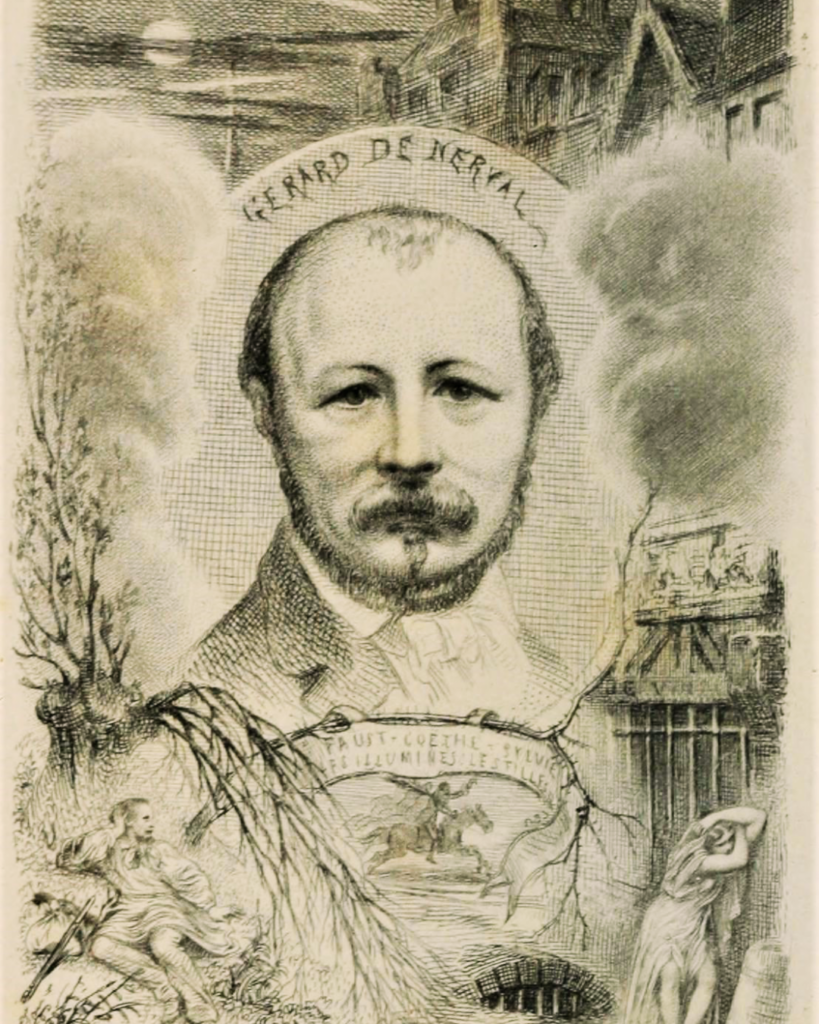
Gérard de Nerval seems to belong to that rare order of writers whose lives enter their own legend before the final page has turned. Around him there remains a silvered atmosphere, half candle smoke, half dawn mist, as though his name had drifted towards us through sleep rather than history. To read him is to enter a chamber where memory wears the garments of myth, where sorrow flowers into vision, where the world of the living is forever touched by the soft hand of the departed. Born Gérard Labrunie in 1808, he came into the century with a temperament already turned towards inward kingdoms. Paris would become one of his great stages, though never merely as a city of stone, boulevard and crowd. Under his gaze, it trembled into something older, stranger, almost ceremonial. Streets acquired the hush of processions. Gardens held a liturgy of shadows. Windows, arcades, inns and alleyways seemed to shelter fragments of a hidden script. Few writers have walked through the modern city with such antique eyes.
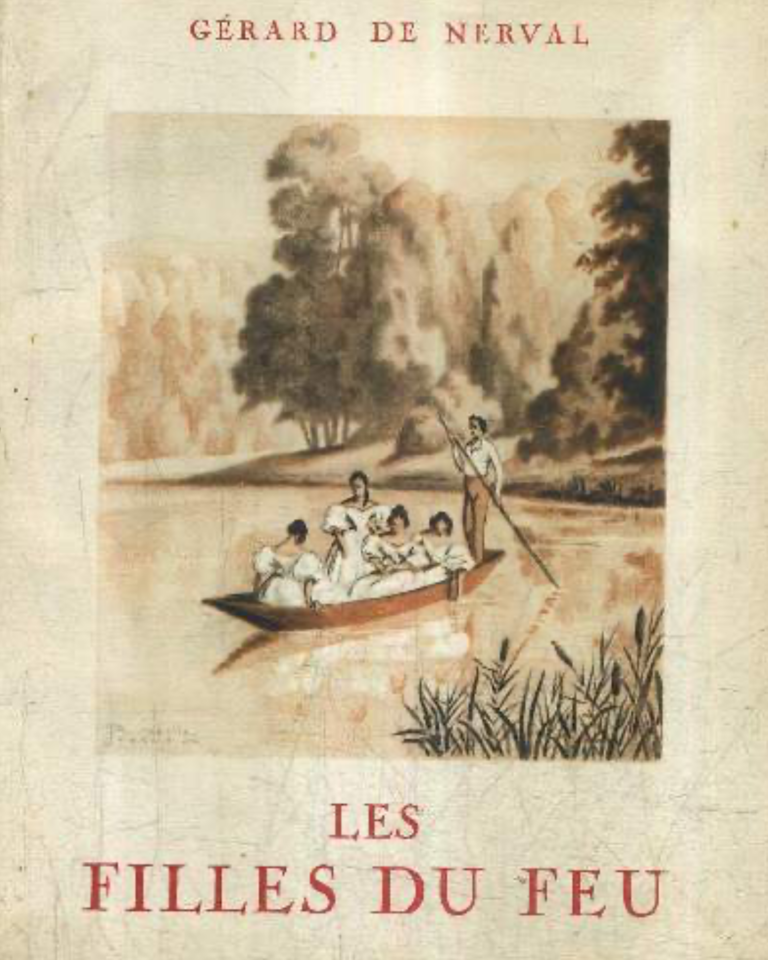
From early on, Nerval moved among the great currents of French Romanticism, yet he carried within that movement a note entirely his own. He translated Goethe’s Faust while still young, and in that gesture one already senses an affinity with works shaped by longing, metamorphosis and spiritual unrest. Translation, for Nerval, was never a mechanical act. It resembled invocation. He approached language as one approaches a threshold, listening for echoes, summoning presences, letting one soul pass into another through cadence and breath. His work unfolded across forms with an almost enchanted fluidity. Poetry, prose, travel writing, journalism, reverie, tale: each became, in his hands, a vessel for inner weather. Yet whatever the genre, the same atmosphere persists. His sentences seem to arrive from a borderland where recollection has grown luminous and unstable. Images return as though from a former life. Women appear with the aura of saints, actresses, muses, queens and ghosts. Names carry secret ancestry. Time curls in upon itself like incense. Nowhere is this more moving than in Sylvie, that brief and perfect work whose grace continues to astonish. In its pages, love is braided with absence, and the past survives with the fragile brilliance of pressed flowers. The narrative moves through memory as though through a series of veils. Each figure seems near, then recedes. Each place glows, then dims.


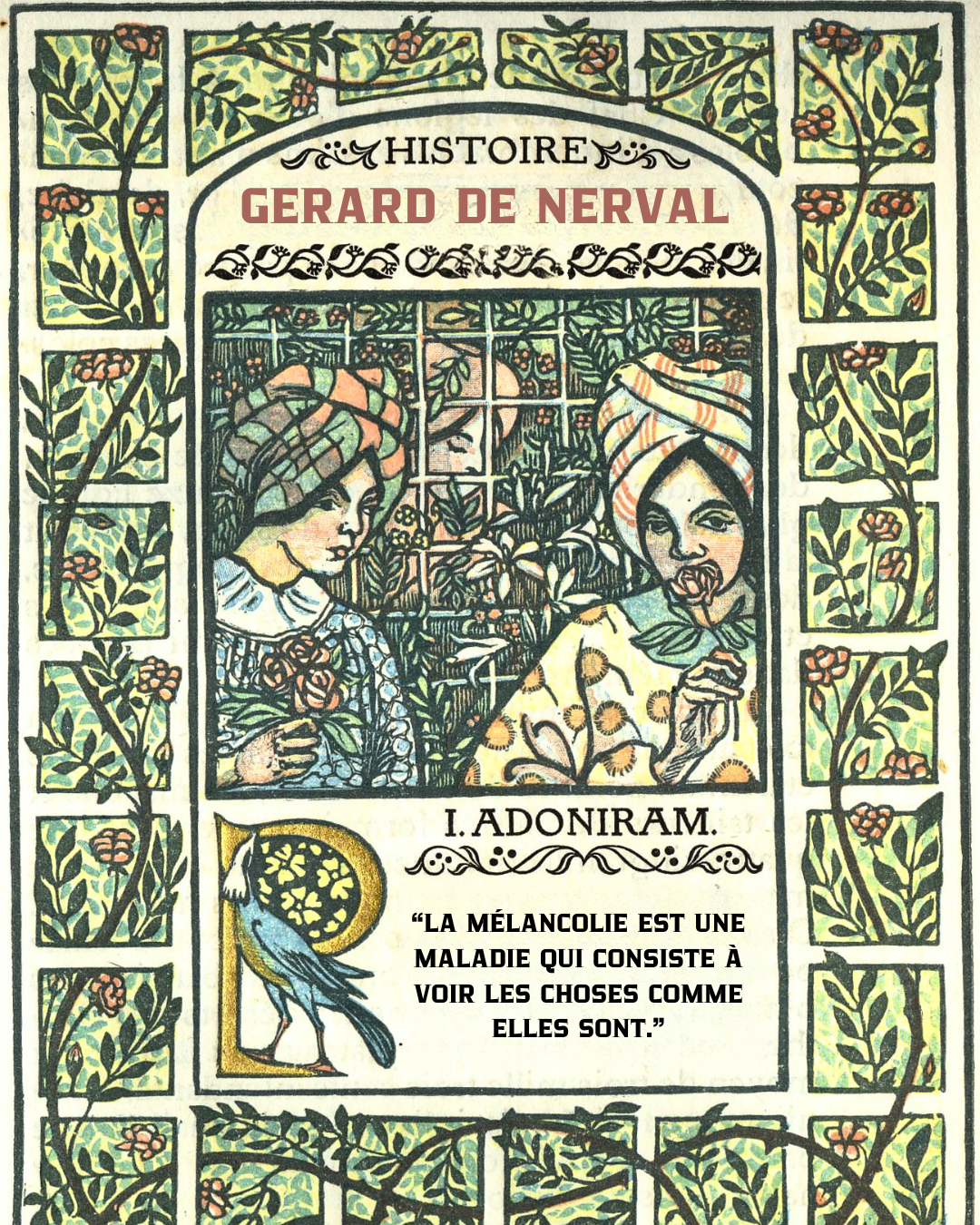
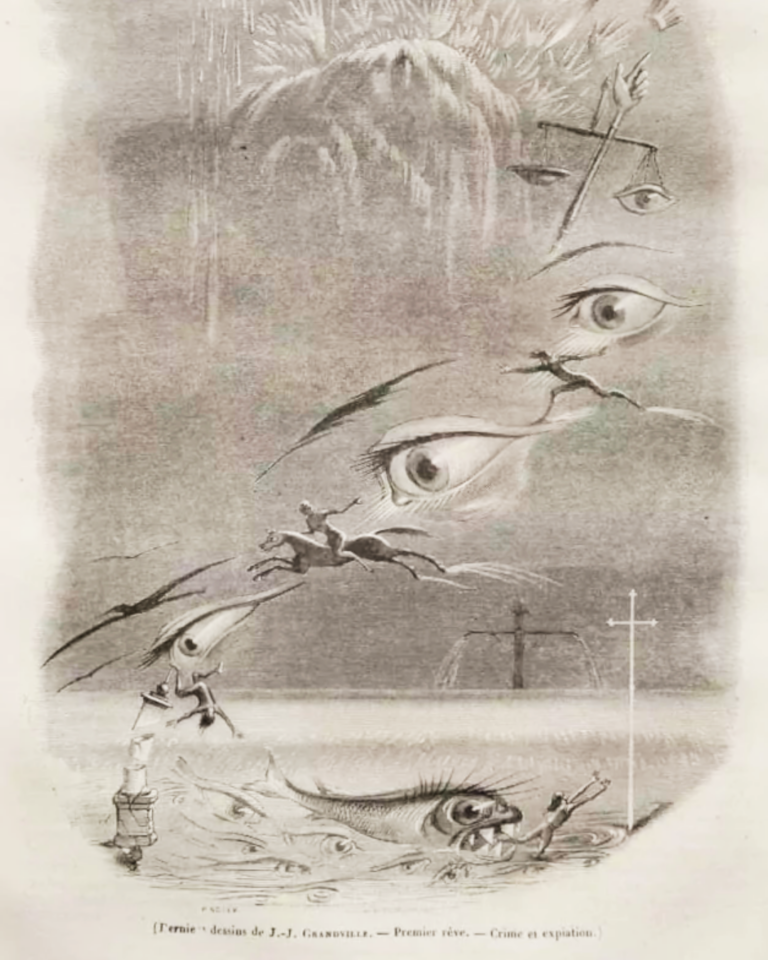
The heart advances through this landscape with devotion, carrying the ache of something once possible, once touched, now remote. Sylvie possesses the delicacy of lace and the gravity of an old prayer. Every scene appears suspended between awakening and dream. If Sylvie offers the pastoral radiance of remembrance, Aurélia descends into a more perilous country. There, Nerval writes from within the trembling geography of visions, mental fracture and metaphysical hunger. The text feels less composed than received, as though dictated by a realm whose laws belong to dream, symbol and revelation. Stars, mothers, beloveds, temples, signs: all gather in a procession of inner emblems. The soul wanders through catastrophe seeking meaning, and language becomes at once lantern and labyrinth. In these pages one does not simply witness suffering. One enters a sacred disorder, a cosmos broken open. This is part of what makes Nerval so enduring. He does not treat dream as ornament. He grants it dignity, structure, spiritual consequence.
Long before the Surrealists recognised him as one of their luminous forebears, he had already understood that the unconscious speaks in a severe and marvellous tongue. His visions are never mere fantasy. They carry weight, omen, ancestry. They seem to rise from a depth where private grief meets mythic pattern. In Nerval, the self is never sealed within itself. It opens onto legend, religion, memory and fate. His travels to the Middle East deepened this impulse towards the symbolic and the sacred. In Voyage en Orient, place becomes more than geography. It turns into ceremony, mirage, mirror. Landscapes shimmer with scriptural resonance. Customs, stories and ruins enter his imagination as part of a wider dream of origins. Nerval travelled with the eye of a poet and the hunger of a pilgrim. He sought a spiritual theatre broad enough to contain his inner multiplicity, and in the East he found forms, images and rhythms that enlarged his already visionary sensibility. Yet for all his attraction to myth and mystery, Nerval remains exquisitely human. His writing carries a tenderness that saves it from abstraction. One feels his loneliness, his fidelity to lost figures, his susceptibility to beauty, his terrible openness to psychic storm. Even his strangeness has the texture of vulnerability. He does not posture before the abyss. He listens to it. He suffers its music. In this, his work acquires an intimacy that still reaches us with startling force.


The end of his life has often cast its dark veil across the reading of his work. In 1855, he died by suicide in a Paris street, leaving behind one of the most haunting silhouettes in literary history. Yet to reduce him to tragedy would be to miss the strange radiance he bequeathed to literature. Nerval belongs among those writers who transformed fragility into form, dereliction into vision, grief into a language of almost sacred clarity. He did not write from certainty. He wrote from fracture, yearning, apparition. That is where his beauty abides. In the long gallery of French letters, Gérard de Nerval remains a singular presence: moon-struck, learned, tender, esoteric, wounded. His pages seem woven from ash, velvet, dawn light and memory. They invite us into a world where the dead still murmur through flowers, where streets conceal forgotten temples, where love survives as echo, perfume and star. To read him today is to feel literature recover one of its oldest powers: the power to guide us through darkness carrying a lamp fed by dream.