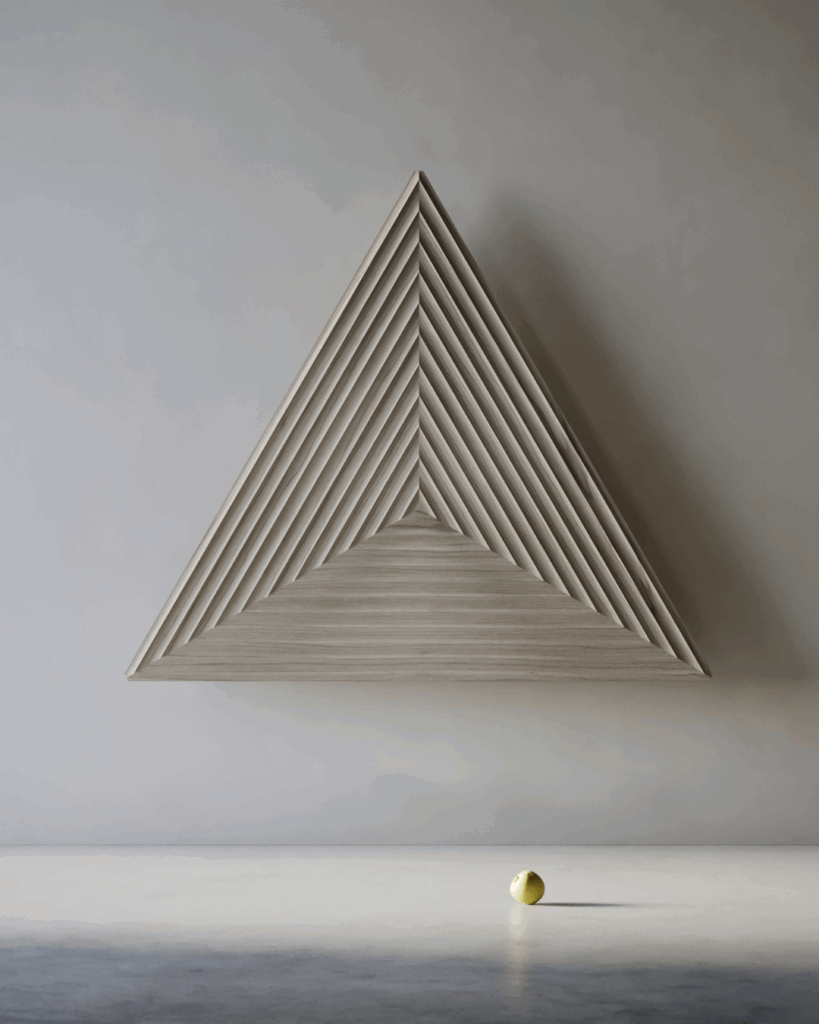
Icosahedron

INHABITING THE UNHEARD

Jacopo Gonzato and the Vibrational Ontology of Form

Words by Anna Maria Giano

To enter the world of Jacopo Gonzato is not to encounter an artist in the conventional sense, but rather to step into a metaphysical vestibule: a space prior to language, anterior even to hearing, where form listens to itself in order to become.                                          His project, Sound Geometry, is neither sculpture nor installation, but a philosophical instrumentarium—an ensemble of resonant bodies through which number, space, and vibration conspire to articulate an epistemology of the invisible.

There is, in the lineage of Western metaphysics, a recurrent yearning to apprehend the world not as accident or chaos, but as order secretly sung — a yearning that stretches from Pythagoras’ monochord to the trembling ratios of Palladian facades, from the Platonic solid to the cathedral vault. Sound Geometry inscribes itself within this tradition not as commentary, but as emanation.
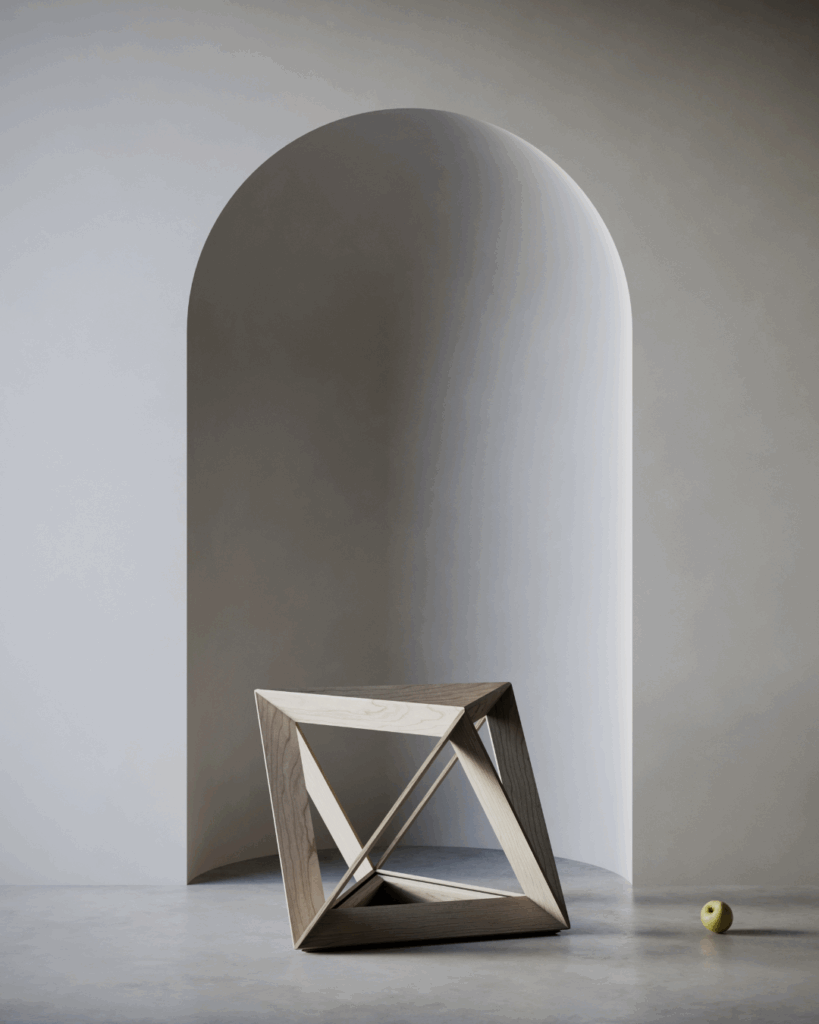
What Jacopo Gonzato renders visible — though the term itself falters here — is not the object as thing, but the object as harmonic potential, as the sedimentation of vibrational will. His polyhedral sculptures — each derived from the five Platonic forms, those elemental matrices that antiquity assigned to earth, air, fire, water, and ether — are not inert structures.
They are frequency-chambers. They resonate with the inaudible: not in the sense of amplifying what escapes the ear, but in reintroducing into matter the awareness of its own architecture.

These are not works to be seen, but thresholds to be crossed.

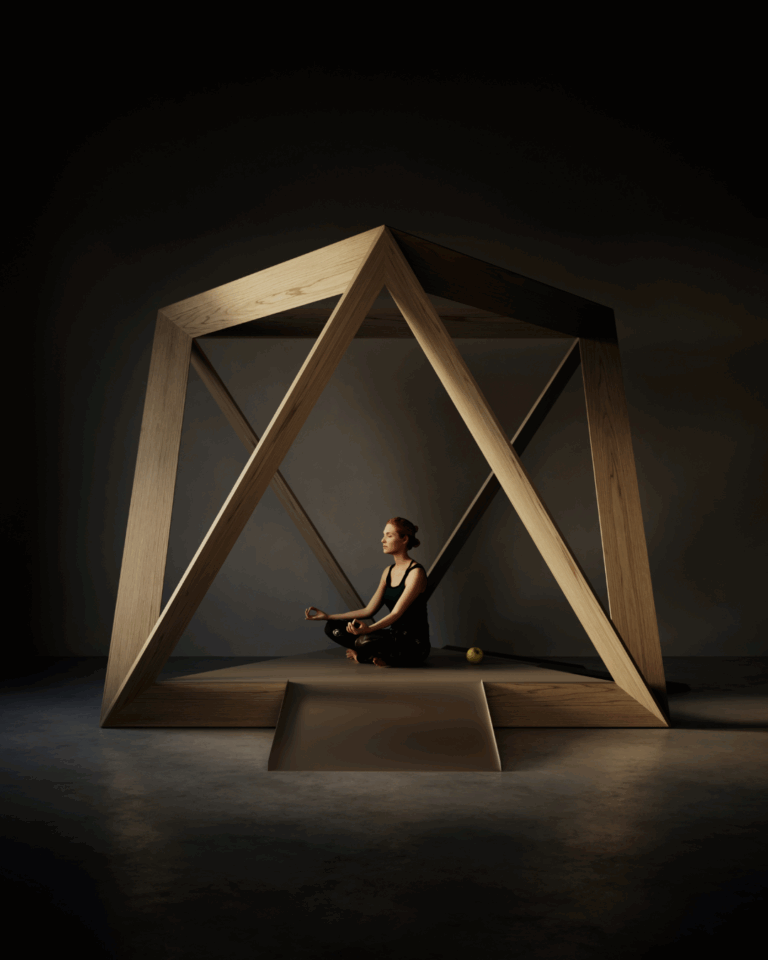
To dwell within one of Gonzato’s masterpieces is to enter a chamber of proportions, a crucible where sonic vibration and geometric rigor are no longer distinguishable. Each facet, angle, and ratio obeys an order that is not merely aesthetic, but cosmogenic. The dodecahedron does not please the eye — it reminds the world of how to exist. One senses, standing within its perimeter, not simply a vibration of air, but a recalibration of interiority itself. The body becomes a diapason; the breath becomes architecture.
Here, the Aristotelian entelechy — that ontological vector whereby a thing tends toward its own immanent form — resonates with literal force. Sound is no longer a temporal event, but a condition of becoming, a manifestation of telos. Gonzato’s geometry does not contain
sound. It summons it, enfolds it, bends it into consonance with being.
There is, in his work, a profound kinship with the Palladian ideal — not Palladio the architect of villas, but Palladio as the orchestrator of harmonic dwelling, as the one who transcribed into stone the mute harmonies of Vitruvius’ De Architectura. Like Palladio, Gonzato is less concerned with ornament than with order, with the echo of the divine ratio embedded in the visible. The Golden Section, in this context, is not an aesthetic flourish, but a portal into ontological resonance.

And yet, despite its classical scaffolding, Sound Geometry is anything but retrospective. Its silence is not that of the ruin, but of the vibrational unborn. One does not “experience” these works. One is restructured by them. The geometry is not illustrative; it is operative.
Gonzato’s polyhedra recalibrate. In this lies their radicality.

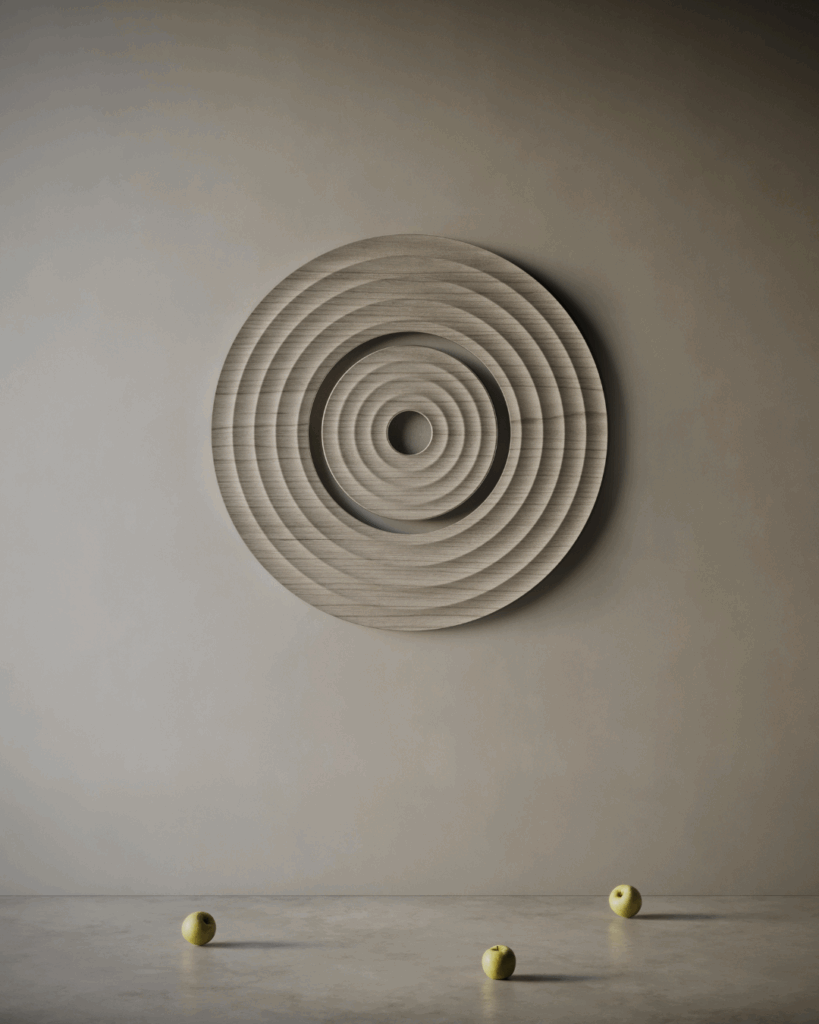
Cerchi Sonori

The installation becomes a site of initiation. The visitor, stripped of visual primacy, is
returned to the pre-cognitive: a listening not with the ears, but with bone, with fascia, with the unknowable plexus where memory and vibration coalesce. It is as though the very ontology of perception is rewritten through resonance.

The tradition of musica universalis — that cosmological doctrine according to which the celestial spheres emit harmonies too perfect to be perceived — finds in Gonzato not a literalist, but a constructor of earthly analogues. His work stages the inaudible through embodiment. The planetary becomes prosthetic. We are permitted, briefly, to inhabit the unheard.

No text can fully convey what his geometries enact. They are instruments that summon
stillness. They are architecture in the etymological sense: archē (beginning) and tekton
(builder). Builders of the origin. Builders of the before.

And perhaps this is what Sound Geometry ultimately proposes: not a new aesthetic, nor
even a new philosophy, but a recollection. A memory of what matter once knew before it solidified. A knowledge older than image, more exacting than word. A silence out of which form, proportion, breath and sound — those four ancient graces — still emerge.

In an era dominated by fleeting images, your work restores to sound a structural presence. From an architectural perspective, how does one construct a form that was never meant to be seen?       

«All begins with the existence of our senses. The reflection at the core of my work attempts to converge them into a single piece. Geometry becomes a vehicle toward absolute beauty because it responds to multisensory canons. Creating these structures, then, means attempting to reveal to the eye what is happening at a sonic level. I know this may sound
rather complex in theory, but in truth, geometry obeys logic, and logic is part of our thinking, so the contemplation and understanding of the work becomes almost instinctive, surprisingly simple».

Plato saw in the geometric solids the deep order of the cosmos. Your works seem to evoke these invisible archetypes, what is your relationship with the Platonic solids?
«For me, they were a point of departure in observing sound. The Platonic solids were actually discovered by Pythagoras, though it was Plato who made them famous—and it was Pythagoras who also uncovered the golden ratio through sound. What’s most fascinating is that only five regular polyhedra are possible, yet they allow you to study and analyse physical phenomena. Pacioli too employed them in relational and geometric terms, before turning to a certain Leonardo da Vinci, whom he asked to render and construct them visually. It was through this synergistic work with Pacioli that Leonardo began to understand the behaviour of light».

In your installations, sonic vibration is often embedded within three-dimensional geometries. Which materials and technologies do you favour in achieving harmony between resonance and form?
«The design of sound moves across three parameters: form, material, and scale. Wood has allowed me to work fluidly across all of these aspects. But that was just the beginning, I am now experimenting with metals, stone, glass, and ceramics».

Your structures recall both the constructive grids of architecture and the harmonic
maps of music. How do you balance mathematical rigour and intuitive impulse in your
design process?
«To break the rules, you must first know them—and, above all, you must know them in order to improvise. John Lennon said that music is organised chaos, and I deeply resonate with that idea. In my research, I need rigour in order to make the chaos visible».

Your projects seem to hold a tension between lightness and stability, between
engineering precision and the volatility of sound. What is your idea of balance in sonic architecture?
«There is no beauty without suffering. The most powerful beauty is that of birth, and yet
when a child is born, the mother suffers terribly in giving life. For me, it’s the same. When I create, I suffer immensely, and this suffering reflects itself in the creatures I shape. I suffer from uncertainty, and this has led me to understand that, when it comes to beauty, speaking of equilibrium is almost impossible, because beauty is an independent process, one we can never fully govern».

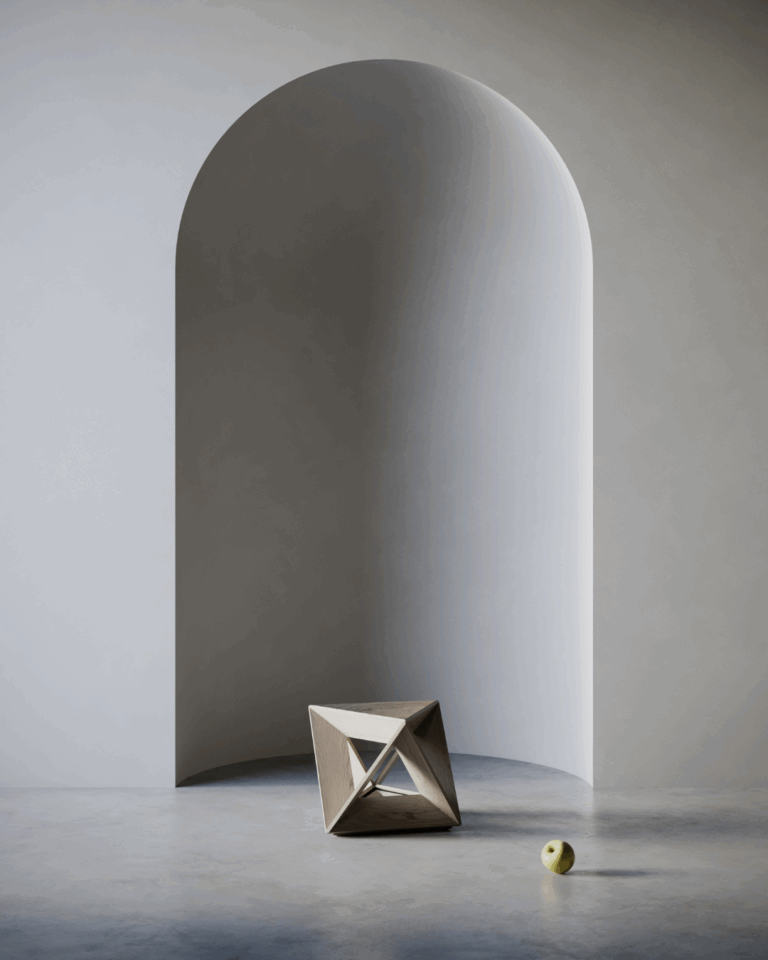
Icosahedron

Your installations seem to generate emotional microclimates. What kind of relationship do you envision between architectural space, visitor experience, and the unfolding of sound?
«They are microcosms, where everything coexists. For me, it’s about creating spaces and objects of contemplation, ones that hypnotise you and allow you to come into contact with your inner self. It is a kind of beauty that responds to the soul and to its states, which is why it aspires to the eternal».

And in one word, is there something you search for when contemplating your work?
«Catharsis».

Some of your works recall models of sacred geometry and biomimicry. To what extent are you inspired by natural and organic structures in designing your modules?
«In this, my vision is profoundly Renaissance: I believe that old concepts must be brought together in order to generate something new. It is a form of deep respect and humility — towards what other men have done before us, and above all, towards what nature has done.
Nature is the first great architect. We can only learn».

There seems to be an echo of Gothic cathedrals in your projects — structures that are complex, light, vertical, filled with both light and sound. Is there a historical architecture you feel particularly attuned to?

«I’m very classical in this sense. I was born and raised in Vicenza, the city of Palladio, and for me, his architecture holds something truly extraordinary. He spoke of a white magic intrinsic to the world of architecture — stemming from its relationship with natural cycles, such as when to collect sand, when to fell timber, and so forth. He also designed the first enclosed theatre in history, and always blended knowledge from diverse disciplines, even in his time. That said, moving away from the figure of Palladio, I would say that — purely in terms of aesthetics — the style I love most is Liberty».

Yours is an artistic practice but also a meditation on the forms of knowledge. Do you believe art must take up and continue the discourses initiated by philosophy and science?
«Absolutely. I always return to the idea of connection. Everything in life is interconnected — each phenomenon bound to another — in a sacred web of correspondences that echo toward infinity. There can be no true architecture without philosophy, and no philosophy without science».

What do you hope will happen to the viewer who enters one of your installations? What kind of perceptual transformation do you envision?
«My greatest hope is that they feel something — that their spiritual core be shaken, and resonate in synchrony with the emotions of the sound».

And ultimately, do you believe that through sound we can still touch the mystery—or, to borrow Rainer Maria Rilke’s words, “inhabit the world as if it were a blessed enigma” ?
«Yes, I truly believe so. If the world is indeed blessed, then we must surrender to the flow of things, for it means that there is always a divine component seeding beauty and positivity into life. At the same time, the notion of ‘inhabiting’ is something profoundly tangible — alive and embodied — something that enfolds you. I believe Rilke’s words can be distilled into a single one: acceptance. And there is no process more difficult».

What remains, after the vibration has passed, is not the memory of sound, but the geometry it has left in the dark. A blueprint etched in silence. A pulse without origin.

Perhaps the work was never meant to be heard.

Something has been touched. Something has been unsealed.
But whatever it is, it does not speak.
It vibrates.

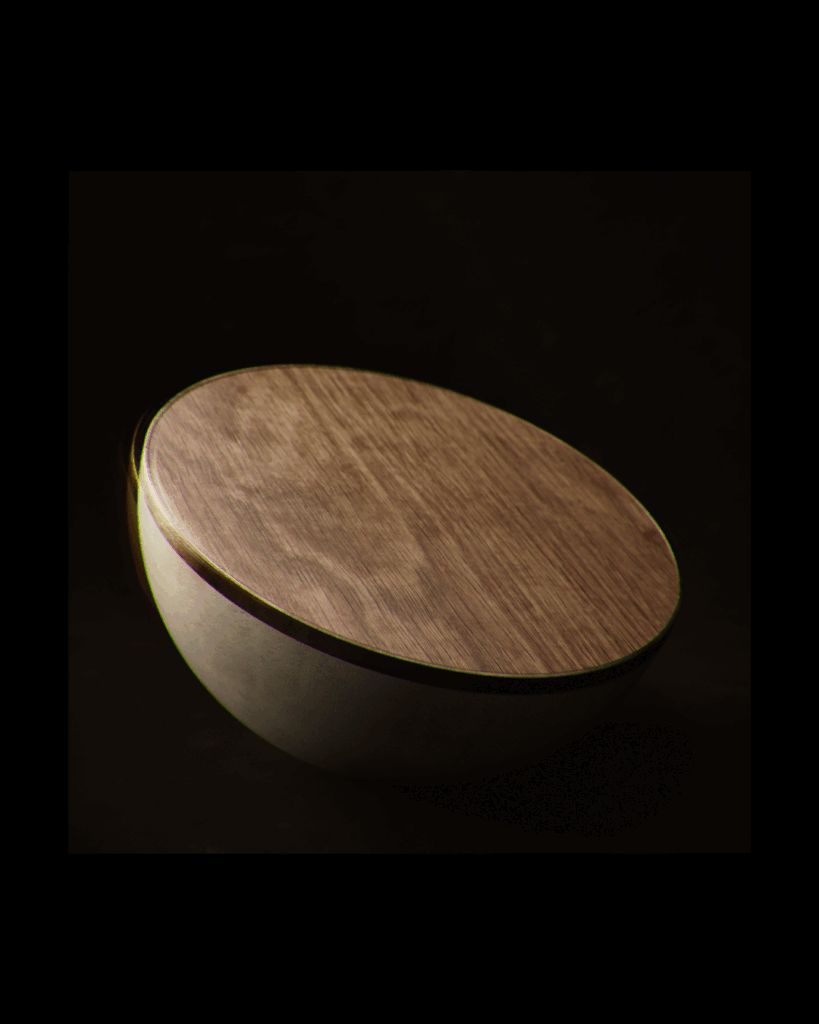
Hemis

Further Reading

Are you a sensitive and curious traveler, constantly searching for beauty, art and cultural inspiration? Sign up to receive the latest contemporary news!