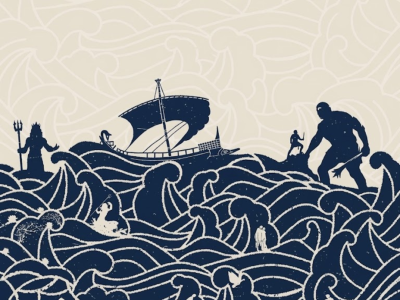
by Francesca Leoneschi and Iacopo Bruno
Inseparabili is the latest book by Francesca Leoneschi and Iacopo Bruno, partners in life and work. The story has being conceived by them together and the illustrations are by Iacopo Bruno. The words and the images seem to have been born together, inspiring each other in a wonderful dialogue between word and image. Today you can get your copy in Italy, France and Spain (in spanish and catalan).
Antonella Dellepiane Pescetto : Was there a specific moment and place when the idea for the protagonist of Inseparabili came to you? Francesca Leoneschi & Iacopo Bruno: We were in front of the Cinque Terre, on our fishing boat Alina, together with some dear friends. We were talking about the need to find a place that could be linked to our idea of representing Victorian mourning in the story and a character that would captivate us.
They joked, “An octopus”. And in that instant, the image came to us: cuttlefish squirting their ink during funerals, turning the sea black. Manta rays coming from all directions to obscure the sunlight filtering through the surface.
At that moment, we knew we had our story.
A.D.P : What were the main inspirations for this plot? F.L & I.B : We started with a simple, very topical question. At a time when the theme of accepting difference is necessary, what happens when two different beings meet and find in each other the missing part of themselves? The inspirations come from personal experiences of unbreakable friendships, but also from the sea, which for us represents freedom and rebirth. We tried to portray vulnerability as a form of strength, and empathy as a universal language.
In terms of narrative references, Tracy Chevalier’s The Fallen Angel introduced us to Victorian mourning, an era we are very fascinated by, and how every behavioural or aesthetic detail can tell a story. And then there was the documentary A Friend at the Bottom of the Sea, which touched us with the delicacy with which it tells the story of an impossible friendship, fragile but also powerful.


On a visual level, given that images convey stories to us, the suspense and intensity of Arnold Böcklin’s The Isle of the Dead, the landscapes of Miyazaki, Gabriel Dante Rossetti’s Ophelia, and devotional mannequins. All these very different universes contributed to creating the visual voice of the book.
A.D.P : Did the first illustrations take a long time to develop? What visual imagery did you draw on?
F.L & I.B : Yes, the development process was long and very complex. The visual imagery draws on observations of the underwater world, a world as unexplored as space. The light that filters through and slowly fades into the darkness. The continuous movement of the sea. The shadows. We wanted a sea that was not just scenery, but a living character in constant transformation.


A.D.P : How many hours of work does it take to produce the final illustrations?
F.L & I.B : Many, but never the same. An illustration can take 2 days or 5. It is not a technical problem or the difficulty of the illustration, although that is certainly part of it, the drawing, the colour, the details. Even more important than this aspect is the emotional weight, that invisible part of the illustrations that requires not time in the sense of hours, but listening to the story to find the right tone that communicates the emotion of the texts.
A.D.P : Both Lucy and Ichi have lost something. How do you personally relate to the theme of loss and how do you explore it in this book?
F.L & I.B : Ichi has recently lost his beloved father and Lucy, without giving too much away, let’s just say she has lost herself. Loss is part of our entire human experience. It is not a theme to be avoided, but to be lived. Inseparables stems precisely from this, from the desire to give shape to the emptiness that follows every separation, and to discover that in that emptiness, if we know how to nurture it and share it with as important as a friend, something new can be born.
Through Lucy and Ichi, we have tried to convey that losing does not only mean ending, but also transforming. Visual language has helped us to say what words cannot. The blackness of the abyss and then the light and colours that reignite, a transformation that can be seen.
A.D.P : A great friendship that overcomes all barriers, even linguistic ones: what does “barrier” mean to you and how do the protagonists overcome them together?
F.L & I.B : Barriers are often invisible: fear, prejudice, silence. As we said at the beginning, we care deeply about this issue, now more than ever in this historical moment.
Lucy and Ichi encounter many barriers; they belong to different worlds, Lucy and Ichi encounter many barriers; they belong to different worlds, they are of two different species. Yet they manage to overcome them with curiosity, with the desire to understand, in a word, with empathy.
Their friendship will arise precisely from the attempt to communicate even when words are not enough. Because sometimes, to understand each other, you don’t need a vocabulary, but an open heart and mind.
A.D.P : The key to the whole text is the value of empathy. How can we teach empathy to the younger generations, apart from reading this book?
F.L & I.B : We believe that children have a natural capacity for empathy, a precious gift that must
be cherished and nurtured. We think that setting an example is necessary, seeing adults who stop, listen without judging, and accept imperfection could nurture it. Art in all its forms can also be a great tool for teaching empathy because it teaches us to look, to feel, and requires openness and listening through our senses. Inseparables and all books could be that small space where the reader, whether a child or an adult, can welcome and sometimes recognise themselves in others, with respect and curiosity towards what is different.
A.D.P : What role does the antagonist play in this volume? F.L & I.B : The antagonist in Inseparabili is not a “villain” in the traditional sense, but is represented by the Abyss. It manifests itself in the deepest darkness, in the shadows of the sea, an entity that protects the sea from intruders. In the narrative, the
antagonist served to bring out the courage of the protagonists,
because only by overcoming their fear together can they be reborn.
So in Inseparabili there is no clear contrast between good and evil, but a constant tension due to the roles of the characters.
Visually, we wanted the antagonist to be an entity rather than a being, represented by long black tongues that hold those who venture into the deepest underwater world captive.

A.D.P : It is not easy to tackle the subject of death and grief in a book that is also intended for children. How did you deal with these issues in the text?
F.L & I.B : Like in a fairy tale, but without censorship. Talking to children about death means teaching them that love continues in other forms, different from those they are used to.
The visual language allowed us to work with the light that passes through the water, the body that dissolves into the blue, the loneliness in the face of immensity.
Visual language allowed us to work with light passing through water, the body dissolving into blue, and solitude in the face of immensity.
The character of death in the story is represented by a traveller who carries out his act inexorably, without violence. Thus, pain and death are not hidden, but experienced without fear.
A.D.P : For the cemetery of marine souls, what references did you draw on?
F.L & I.B : We were fascinated by the idea that sea creatures could also have rituals, places of remembrance, which live on in time as they do for us. As we said before, the abyss and space are somehow similar. So for us in the Marine Cemetery, the Souls are like floating luminous stars.
A.D.P : You invented “polpesco”, a marine language incomprehensible to humans. How did this language come about? Are there other languages you would like to develop visually?
F.L & I.B : Inseparables has two protagonists who come from different worlds and, as such, they also have a language that is incomprehensible to each other, which they will overcome through empathy. However, the writing is different, their alphabet is different. We wanted Ichi, the little octopus, to also have a voice in the layout, a language dedicated to sea creatures. This is why polpesco flows smoothly through the pages of the book. It is a text to be observed, not deciphered. I don’t know if we will develop other languages, but for us typography is a visual language as much as illustration, so to answer your question, every time we design a cover we look for a visual language composed of typographic characters which, in the case of Iacopo, are always hand-drawn.


A.D.P : What fonts did you use in the text? F.L & I.B : The aim of the typographical choice was to create a dialogue between the written word and the image, without one overpowering the other. Each typographical choice was therefore conceived as part of the visual narrative.
For the text, we chose Cal Bodoni Casale, a modern reinterpretation of the famous Bodoni font family. It is a serif typeface,characterised by strong contrasts between
thick and thin lines, which we like for its elegance and its history, deeply rooted in the typographic tradition of our country. It is a font that gives rhythm and breath to the page.
For the titles, on the other hand, we chose Cal Bodoni Terracina, a script that, thanks to its fluid design, is reminiscent of the movement of waves. Together, the two fonts create a balance between rigour and lightness, combining the structure of the page with the freedom of visual flow.

A.D.P : The appendix, as in your other publications, is a richly illustrated afterword. Which sketches are your favourites and how does the illustration evolve from the sketch?
F.L & I.B : In our books, we choose to include the sketches in the afterword because we like to show the process, because they tell the story of the journey. The illustration evolves through layers, from pencil sketches to watercolours, to some details with coloured pencils. The illustration evolves in layers, from pencil sketches to watercolours, to some details with coloured pencils. Showing the process means inviting the reader behind the scenes of creation, into our workshop. In reality, we don’t have favourite illustrations, but we do have one that we are particularly attached to, and that is the one of the Prince Consort, the funeral poster, because it was the first to be created and revealed the emotional tone of the whole book to us.
A.D.P : You opened the book with Shakespeare’s extraordinary quote from Hamlet: “Those friends whose friendship you have already tested, hook them to your soul with steel hooks.” The bond between Lucy and Ichi is a friendship that overcomes all barriers, even linguistic ones: what does “barrier” mean to you and how do the protagonists overcome them together?
F.L & I.B : That quote moves us every time we read it. The image of friendship as something to be “caught in the soul with steel hooks” is a profound promise, built over time and through trials, of something that remains even when everything else changes. For us, friendship is a form of home, a space where we can show our vulnerability. We often find it in animals, in places, even in objects that carry the memory of who we once were. Ultimately, Inseparables is also a declaration of love for these invisible relationships that keep us connected to the world.
A.D.P : Speaking of unearthly friendships, one of your references for this book was also the documentary A Friend at the Bottom of the Sea, about the deep bond that develops between a researcher/diver and an octopus. Have you had similar experiences with animals? F.L & I.B : Last May, I had an incredible experience, something that had never happened to me before. We had just finished writing the book, it was early morning and there was no one in the water. I only went in up to my legs because the water was still freezing cold.
At one point, I felt something brush against my foot, and then a second time. The water was clear and still, and when I approached the surface to look, I saw a small octopus brushing against me with a tentacle. Ichi was there with me. I tried to touch its head and, at that moment, it stretched out a tentacle and wrapped it around my hand. I took it as a sign, and it was a moment of pure emotion, a brief but very deep connection.
A.D.P : You presented the book with Miraphora Mina from MinaLima Design as moderator. How did that go and what is your relationship with her and Lima like?
F.L & I.B : We met for the first time at the Bologna Children’s Book Fair, at their stand, introduced by a German publisher with whom we both work. It was love at first sight, one of those rare professional relationships based on mutual respect and a shared vision. MinaLimaDesign is a benchmark in our field. Mira and Eduardo have redefined the dialogue between words and images, creating a new graphic style.
After our meeting, we sent them the PDF of the book and their response was warm.
They loved Inseparabili! And who better than them to write a quote? And so it was, they dedicated wonderful words to us, which we are truly honoured by and which you will find alongside those of Riccardo Falcinelli (also
wonderful!) on the back cover of the book.
Over time, a friendship with Mira has developed that goes beyond work. When they asked us to present Inseparabili at LuccaComics, we thought we would like to be there with her to share this important professional moment.
I know you offered personalisation of the volume with an ex libris and an illustration by Iacopo.
A.D.P : How does the artist relate to the limited time available for the dedication and personalisation?
F.L & I.B : The time for the dedication is short, but it requires great concentration.
Every drawing, even the smallest, is a transfer of emotions between the illustrator and the reader.


It is Every drawing, even the smallest, is a transfer of emotions between the illustrator and the reader. It is a way of giving something personal back to those who have chosen to immerse themselves in our story.
A.D.P : Are there any new or old ideas you are already working on? Can you give us a few key words? F.L & I.B : We always have a few stories floating around in our heads. We can’t reveal too much, but we can say that we are returning to explore the boundary between human and non-human, light and darkness, presence and memory. The key word will be Memory, and it already speaks, in some way, of our next journey…

What are you waiting for? Get your copy here: https://www.rizzolilibri.it/libri/inseparabili/
Inseparabili is also the perfect Christmas present.
Discover the Parisian studio of Alice Malaret, the food designer who turns art into a tasting experience.
Unveiling the dialogue between Florence Welch and Autumn de Wilde, where music and vision converge to shape feverish images, ritual gestures, and a rare sense of visual enchantment.
Step through the threshold of the magical world of White Lands, the antiquarian bookshop in Turin founded by Luca Cena.

An in-depth conversation with multimedia journalist and science reporter Silvia Lazzaris.
Are you a sensitive and curious traveler, constantly searching for beauty, art and cultural inspiration? Sign up to receive the latest contemporary news!