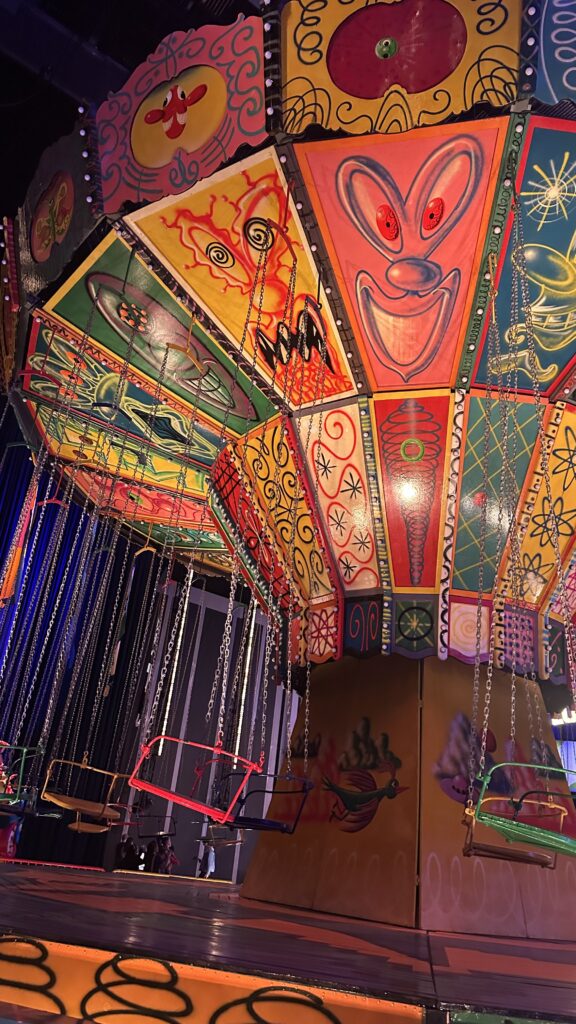
There is a place where art refuses to remain confined purely inside the gallery walls: the rebirth of Luna Luna, an avant-garde carnival of dreams where primary-colored amusements rides swirl and perfectly paired classical music mingles with neon graffiti. Far from being just another art exhibition, Luna Luna teeters at the intersection of wonder and nostalgia. Wrapped in a timeless story that spans six decades and transverse continents. A carnivalesque meeting ground for visionary artists who dared to blur the line between creator and spectator, featuring international artists like Jean-Michel Basquiat, Roy Lichtenstein, Salvador Dalí, David Hockney, Keith Haring, and Kenny Scharf.
Vanished into obscurity for forty years, Luna Luna has recently found its second wind thanks to the restoration investment led by the Canadian rapper, Drake. To fully appreciate why these attractions feel so alive today, it helps to revisit the carnival’s extraordinary origin story and the decades-long odyssey that shaped it. Luna Luna had a sensational premiere in Hamburg, Germany, summer of 1987. Devised by Austrian maverick André Heller, he invited 32 internationally renowned artists to construct a carnival that fused art, spectacle, and childlike play. Over seven weeks, nearly 300,000 visitors roamed the grounds beneath the big open sky, engaging with vibrant, interactive installations that double as carnival rides.
Despite its popularity, Luna Luna lasted only one summer. The rides were dismantled and placed into 44 shipping containers, primed for a world tour from Europe to the United States. Heller had ambitious plans for his carnival, exploring possibilities, but ran out of time and money. Eventually, a philanthropic foundation in the United States purchased the entire spectacle, aiming to resurrect it in San Diego’s Balboa Park. But hopes swiftly unraveled due to unending complications. The installation ended up out in a remote field in the Texas desert. The crates sat under the scorching sun for decades, while rattlesnakes and scripons became its only visitors – completely forgotten. Basquiat’s Ferris wheel — remained hidden, still emblazoned with his signature scrawls, and Keith Haring’s carousel lay gathering dust. Without the internet or social media, the art world moved on; Luna Luna, was no longer a sensation, simply vanished from collective memory.
Yet, some treasures cannot remain hidden forever. Rumors of an abandoned “art amusement park” reached rapper Drake in 2020. Intrigued by the carnival’s quirky backstory and the impressive roster of artists, a $100 million pledge was made to restore and relaunch Luna Luna. Teams of engineers, art restorers, and cultural historians descended on those neglected containers to reveal lost masterpieces. Each ride and installation underwent painstaking rehabilitation: chipped paint was lovingly touched up, mechanical parts were replaced, and rust was scrubbed away to once again showcase the brilliant designs beneath.
The result of this extensive restoration was recently showcased in Los Angeles and is now on display in New York City, featuring roughly half of the original art installations. In its new incarnation, Luna Luna merges the old with the new. The show’s star is Basquiat’s Ferris wheel, including an irreverent giant monkey’s-butt motif now spinning under contemporary lighting that highlights his expressive brushwork. Haring’s carousel still bursts with his vibrant pop-graffiti shapes, while Scharf’s whimsical chair swing captures the same tongue-in-cheek irreverence of 1980s New York. Harmonizing music with synchronized lighting illuminate these vintage rides. And, of course, nostalgia as costumed circus performers and animals wander around and perform an occasional humorous show. But, unfortunately, the rides aren’t available for a whirl. However, you can get lost in Lichtenstein’s disorienting glass maze, shadow play in Hockney’s fantastical tree house, and enter Dalí’s kaleidoscopic chambers distorted to experience the blend of dream and reality.
What made Luna Luna originally so captivating was the childlike sense of wonder. Documentary footage from that summer shows children and adults alike dashing from ride to ride, stilt-walkers weaving through crowds, and costumed jugglers. Crowds giggled at the bizarre “Palace of the Winds,” a performance centered on amplified flatulence accompanied by a concert violinist—a part of Europe’s 1980s counterculture. Everything in Luna Luna carried a raw, joyous energy, revealing how art could feel communal and accessible. The event combined a mix of artistic styles of surrealism, pop art, abstraction, and nouveau realism – established masters like Dalí and Lichtenstein brushed shoulders with emerging stars such as Haring and Basquiat. Even Andy Warhol, who passed away just months before the carnival opened, was commemorated with a photo booth so attendees could snap playful pictures alongside cutouts of Marilyn Monroe and Albert Einstein—his trademark wink at the idea of 15 minutes of fame.
Arik Brauer
Pic by ⓒ Orlando Tales
Roy Lichtenstein
Pic by ⓒ Orlando Tales
David Hockney
Pic by ⓒ Orlando Tales
Sonia Delaunay Pic by ⓒ Orlando Tales
Although Luna Luna now enjoys modern enhancements, it remains an homage to André Heller’s original vision. His dream was for artists to play like children in the mediums of their youth—rides and carnival games—and then share their creations so the public, too, could experience unbridled wonder. Luna Luna is a reminder that art can be interactive and lighthearted and doesn’t have to be taken too seriously.
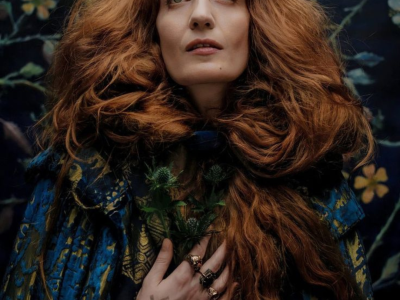
Unveiling the dialogue between Florence Welch and Autumn de Wilde, where music and vision converge to shape feverish images, ritual gestures, and a rare sense of visual enchantment.
An in-depth conversation with multimedia journalist and science reporter Silvia Lazzaris.
By Antonella Dellepiane Pescetto
Are you a sensitive and curious traveler, constantly searching for beauty, art and cultural inspiration? Sign up to receive the latest contemporary news!