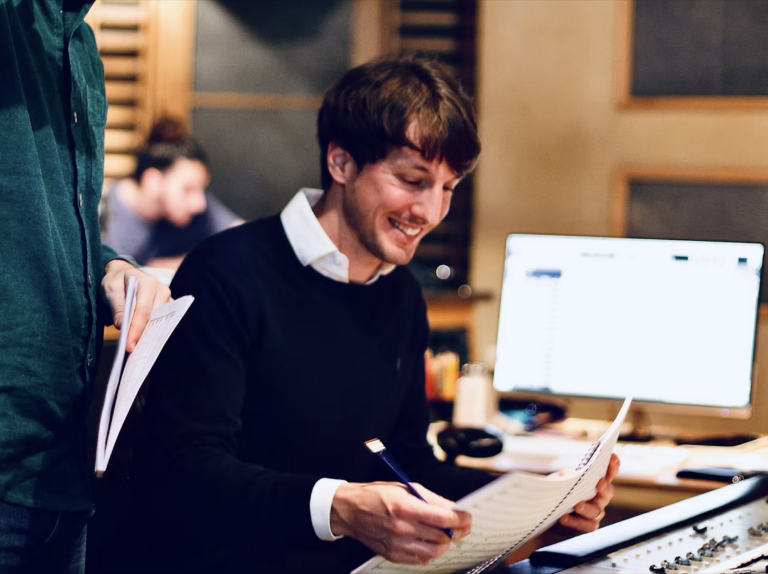
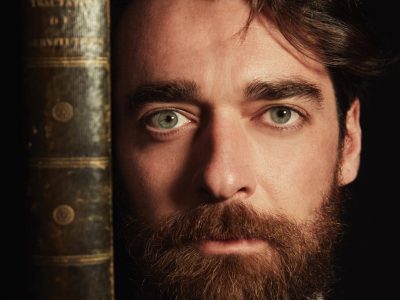
Stefano Fasce is an Italian award winning composer and multi-instrumentalist based in London, known for his versatility and musical range.
He holds an MA in Composing for Film & TV from the prestigious National Film & Television School (NFTS). He also earned a Specialist Certificate in Orchestration for Film & TV from Berklee College of Music.
In 2018, he obtained an MA in Composing for Film & tv at the National Film & Television School in the UK. Fasce worked on a series of documentaries on the History Channel, and animation films. He was also selected for the BFI Network x BAFTA Crew, a year-long talent development programme.
Many of his works have been recorded at the renowned Angel Studios in London.
Stefano, the composer’s mind is one of the most complex and articulated. As in the film August Rush, we all ask ourselves: how does music come to you? What or who whispers it into your ears? Does your inspiration draw on nature, art or loved ones? Do you have such a thing as a hierarchy of inspiration?
Music comes to me in different ways. If I work on a film, before composing anything I would have a meeting with the director/producer where we talk extensively about the music, their thoughts on it, my suggestions. So, in that case, there’s usually a starting point, an overall direction given by the film itself, that shapes and inspires the composition and the instrumentation I’ll use. When I compose for personal projects, I’m inspired by various things. I like to have an image in my mind, a theme, that can be physical or abstract. Hope, nature, life, art, relationships, death – they’re all themes that inspire me and help me create.
How do you manage your creative process? Where do your compositions usually originate? From the main theme?
There’s usually a core idea that I develop, and this idea could come from a sound, a chord progression, a melody, a rhythm. That is the seed of the composition. From then on, anything can happen! I think a good analogy is painting. When you have a blank canvas there are endless possibilities. It takes time, instinct and will in order to experiment and not to be afraid to try new things, and it can be really rewarding once you see or rather, hear, all the pieces coming together.
I like thematic writing, and I’m naturally inclined to write themes. In films, I usually start from that since once you have them, it gets a bit easier as you can use and orchestrate them in scenes related to them. For other projects, it depends on the nature of the piece, but I don’t necessarily start from a main theme.
Your latest album… is closely linked to the use of strings and a deep, addictive atmosphere. Talk us through what this album represents to you in your private and professional walk of life.
My album is the most exciting and personal project I’ve worked on this year. The creative process was difficult at first, as it’s like writing a novel, without a plot. Where do you go? Is that the right direction? And more importantly, this is a big statement for me, showing my true self. Who are you as a composer? What do you want to say and why? Nobody’s there to help and having worked on films and tv mostly, where the picture dictates the direction, I found it at first challenging. So, I had some themes running through my head, sometimes, they were physical, sometimes they were abstract feelings. I think hope has been one of the most important themes in the album. And looking back, it evolved so much, ideas changed, I kept digging deeper and deeper, and finally I was really proud of where I ended up. I think both in my private and professional life this is a milestone. It’s something I have made on my own from start to end (with the help of some amazing musicians who recorded on it), and hopefully it will be the first of many. Professionally, I hope this will lead to exciting collaborations with other artists and live performances.
We know that you are skilled at drawing. Do you think you may wish to explore other forms of art in the future? Which are the ones you feel more attracted to?
Good question. Drawing is probably the one form of art I’d like to get more into. I especially like watercolour paintings and Japanese art, so I’d start from there. I think it would be fun one day to try and direct a short film or a documentary, so that’s another idea for the future.
What are your hobbies and passions other than music?
I like climbing (a passion that my wife has passed onto me), Korean dramas and lately food photography. At the moment, I’m also learning Japanese because I’m interested in Japanese culture especially manga. Many interests come and go, but I’m always fascinated by tech and science, so I often listen to podcasts and watch videos related to these subjects.
The life of a freelancer is always based on a delicate balance. Do your family support you? Have they believed in your creative projects?
Being a freelancer is very challenging, so having the support of my family has been very important. I feel really grateful and privileged that my family has always supported me from the very start. They gave me the opportunity to learn an instrument, study at a musical academy and later here in London at the National Film and Television School. I usually send them my latest compositions and ask for feedback, as my dad has always been my number One fan! My wife is also one of the reasons for being here today. I’ll always be thankful for all the love and support she has given me and gives me. Without them, I probably wouldn’t be composing professionally today.
Genius or scoundrel. Many composers have been controversial personalities and difficult to grasp: Berlioz, Schumann and Skrjabin. How do you find your inner balance? Do the Dionysian and Apollonian worlds fight against each other or do they coexist?
I think being in a happy relationship definitely helps with my inner balance, as I have a good routine that I follow, and it gives a structure to my day and my life. Otherwise, I think the urgency of creating could have had negative effects on my well-being. It’s important to know when to stop and focus on yourself. I like the way you put it, I think they coexist, but to go to places I haven’t been before (music-wise) the Dionysian side needs to dominate, burst and explode, and have the Apollonian one aside, until later, when I’m not in the “flow” anymore and I analyse what I have done. For me, music is the culmination of both worlds. It follows mathematical structures, the sound itself is a wave; harmony is based on intervals, but then you have all the other side, the irrational one, the one you can’t fully understand but moves you and makes you feel alive. Otherwise, it would be just numbers.
Why did you feel you had to follow music in your life? Do you remember an episode or some important element which made you fall in love with and follow the muse Euterpe?
I sometimes think about what I would have done without music, had I cho- sen another path. I followed music because it was the only way that made sense to me, and in that I saw my future, my self-realisation, and the premise for an exciting life. Growing up in an artistic family has certainly influenced me. My dad teaches music, my brother plays the piano, my sister used to play the violin and my mum is a skilled painter. Therefore, art and music have been around me closely since I was a child. I can’t recall a single episode that made me fall in love with it, music has been with me since I can remember, and I have always loved it.
Stefano has created original soundtracks for all the Orlando Editorials. Can you tell us how was it working on the first video produced by Orlando, inspired by Ariosto’s Orlando Furioso? What were your thoughts behind the notes?
Working on Orlando was a really interesting and rewarding challenge. As the poem by Ariosto is surprisingly modern for its time, I wanted the music to have a mix of modern and traditional to it. There’s an electronic, rhythmic and textural driving force underneath the orchestra, which keeps the momentum going and pushes the music further, giving it a contemporary sound. The orchestra on the other hand wants to reflect on the grandeur and impact of the poem, and inspired by the beautiful and powerful images of the video, it plays with the imagination and ambiguity of the scenes.