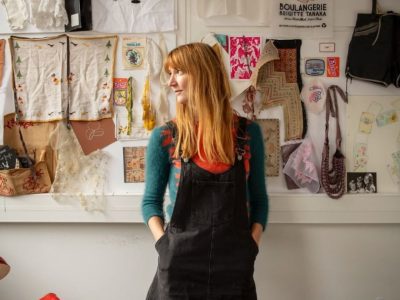
There are cities we walk, and there are cities we thread. Paris is both: a city to traverse and a city to sew, each arrondissement a fabric, each passage a seam. And hidden in the quiet folds of the 2nd, on rue de Choiseul, Ultramod endures like the stitch that binds an otherwise unravelled garment. Established in 1832, it is not a store, but a sanctuary — the last true mercerie of Paris.
Ultramod’s two storefronts sit across from each other like mirrored sighs: one for ribbons, lace, and buttons; the other devoted to millinery, feathers, and felt. To enter is to descend into a slow, textured silence, where drawers slide open with the gravity of confessionals, and nothing — not even a spool of thread — is without meaning. This is Paris not as postcard, but as palimpsest.
Ultramod Paris
In its stillness, Ultramod echoes a verse from Mallarmé: “La chair est triste, hélas! et j’ai lu tous les livres”. And yet here, amid braids of soutache and silk pompons, the flesh feels suddenly illuminated — not by spectacle, but by suggestion. You begin to believe, as Mallarmé did, that objects hold metaphysical resonance, that a button is a syllable in the poem of a life.
A velvet ribbon in imperial purple. A set of pearl buttons the size of a thumbnail. A bolt of antique grosgrain — heavy, ribbed, resistant to time. These are not embellishments, but evidence. A way of being. As Baudelaire wrote in his praise of fashion: “Le beau est toujours bizarre”. At Ultramod, beauty resides in the strange survival of the obsolete — a temple of forgotten fastenings that seem to murmur their provenance to the sensitive.
The clientele is equally poetic: opera costume designers from Palais Garnier; couture artisans from Dior or Chanel; meticulous elderly ladies who recall a time when hems were hand-sewn by necessity, not by affectation; and young stylists who come as if on pilgrimage, hungry for texture and tactility. The conversations are whispered, gestural. Here, to speak is to point, to touch, to compare the grain of taffeta with the glint of moiré.
Detail from "La Mode", an illustration from J. J. Grandville's Un Autre Monde (1844) by Public Domain Library
Since its gentle revival in 2015 under the Fondation Rémy Cointreau, Ultramod has shed none of its integrity. If anything, it has deepened. The shop now collaborates with the Maison d’Artisanat d’Art, ensuring that rare savoir-faire is not lost to oblivion but passed on — thread to thread, word to word. Apprentices stand beside veterans. A future is being stitched, quietly, with reverence.
Time in Ultramod moves differently. It doesn’t march, it folds. It pirouettes, like a dancer circling a hat block. The hands that measure ribbon do so not with urgency, but with ceremony. Each gesture becomes liturgical. The shop’s wooden drawers — worn smooth at the edges — recall the sepia tones of Eugène Atget’s photographs: not nostalgia, but quiet testimony.
Ultramod Paris
Ultramod Paris
Ultramod Paris
And yet this is not a place of mourning. Ultramod is not a mausoleum. It is a salon of the sensual, a citadel of craft, where the ephemeral becomes enduring through attention alone. When you exit, cradling a fragment of guipure lace or a milliner’s needle, you do not leave with a purchase, but with a relic — something weightless, yet grave.
In a time obsessed with the instant and the image, Ultramod insists on the invisible labor behind every visible thing. A hat is not an accessory but a philosophy. A ribbon is not decoration, but diction.
To walk out of Ultramod and back into the Parisian street is to awaken from a dream in which everything — even a spool of thread — had soul.
Unveiling the dialogue between Florence Welch and Autumn de Wilde, where music and vision converge to shape feverish images, ritual gestures, and a rare sense of visual enchantment.
An in-depth conversation with multimedia journalist and science reporter Silvia Lazzaris.
By Antonella Dellepiane Pescetto
Are you a sensitive and curious traveler, constantly searching for beauty, art and cultural inspiration? Sign up to receive the latest contemporary news!