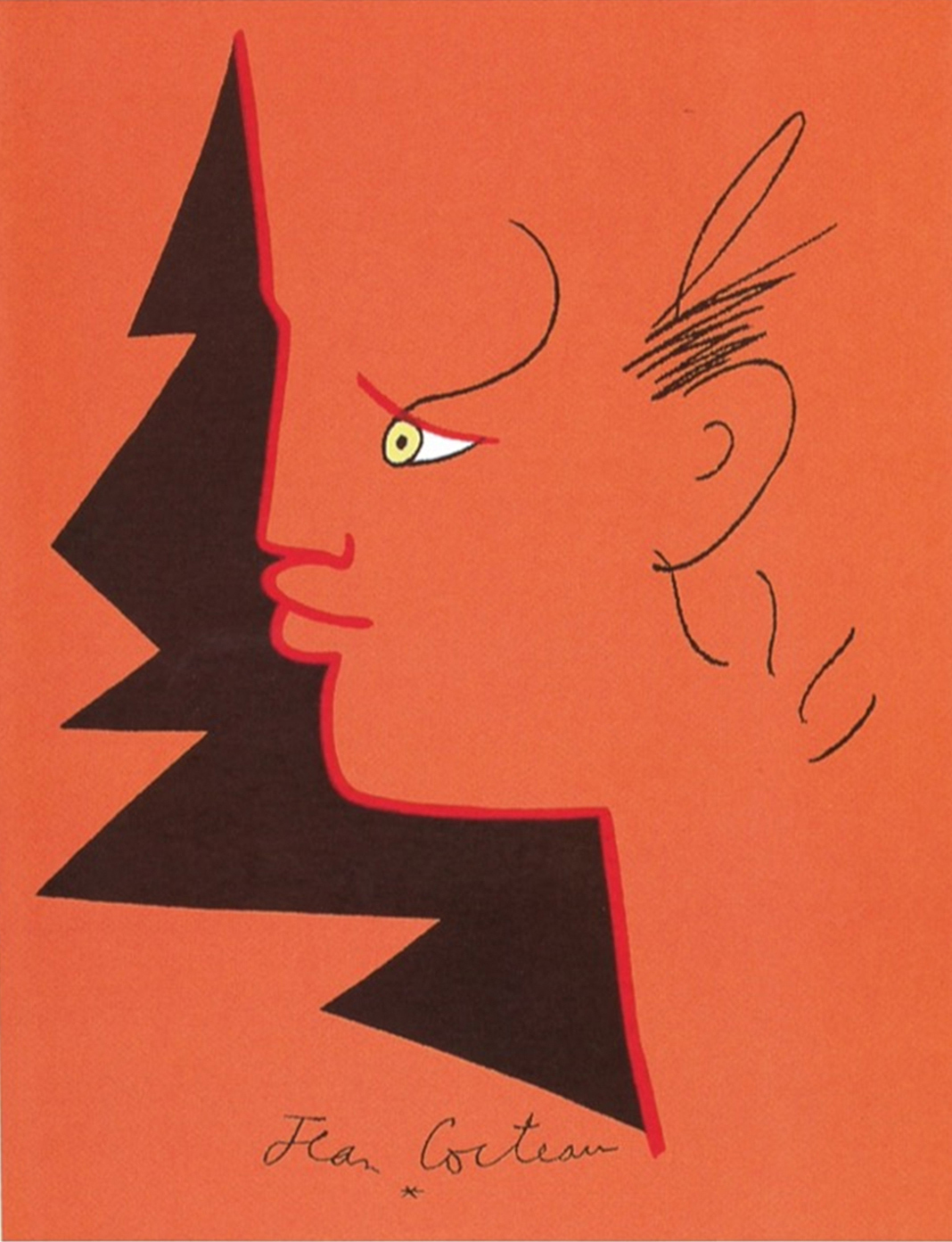
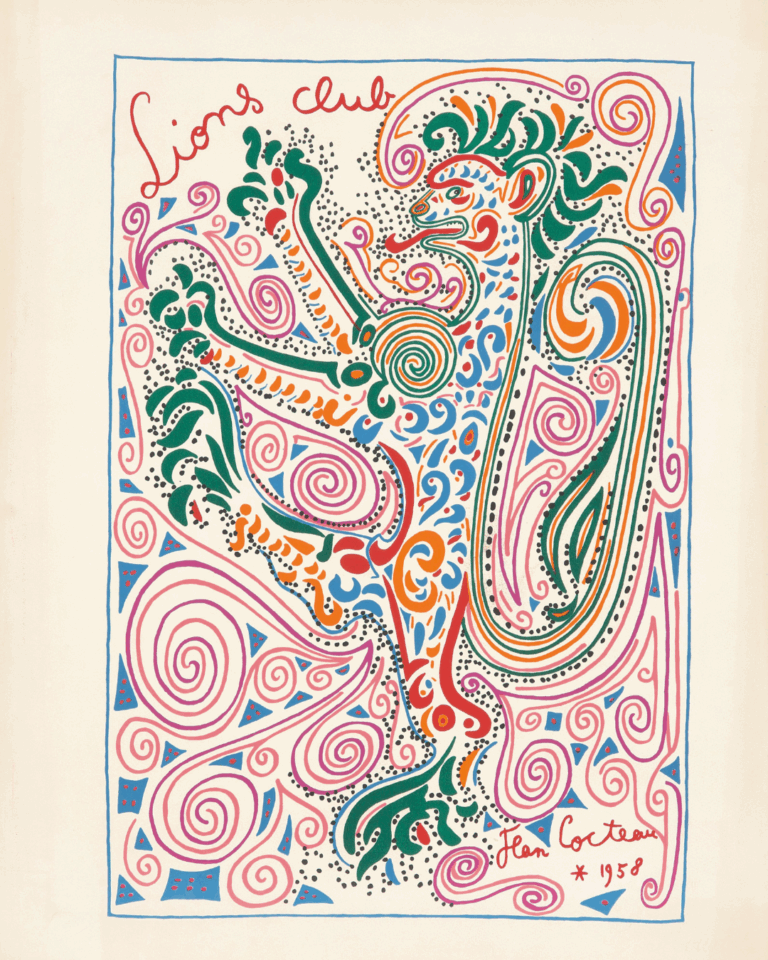
Jean Cocteau, Orphée, 1958, Lithographie; Courtesy from Exhibition at Musée Yves Brayer
POLYTROPOS
Myth, rituals and signs of Jean Cocteau
Words by Anna Maria Giano
Jean Cocteau’s corpus eludes categorical framing.
His work spans multiple disciplines — theatre, prose, drawing, mural painting, fashion — and yet a coherent symbolic system can be traced throughout. Each gesture, whether textual or visual, participates in a network of correspondences structured around transformation, ritual, and the permeability of form.
Edmund White referred to Cocteau as “the most versatile artist of the century”. Susan Sontag emphasised his sustained commitment to style as both method and epistemology. For Cocteau, the artistic act functions as transmission: a way of giving form to what precedes or exceeds discursive language.
His intermedial practice anticipates many of the central concerns of twentieth-century theory: the instability of meaning, the construction of authorship, the performative dimension of the image, and the autonomy of surface. To study Cocteau is to observe the development of a visual-textual mythology in constant elaboration.
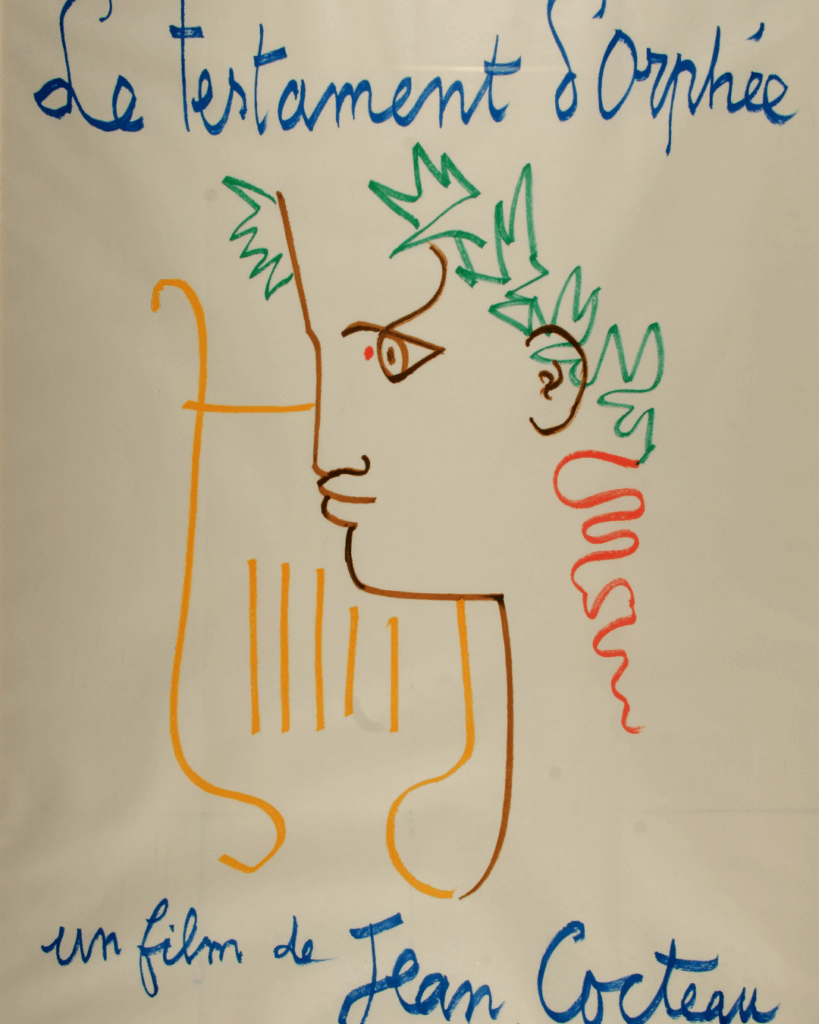
Jean Cocteau, Affiche du Testament d'Orphée, 1960; Courtesy from Exhibition at Musée Yves Brayer
I. THEATRE AS INCANTATION AND SYSTEM
Cocteau’s theatre operates through a logic of symbolic condensation. Psychological realism and linear narrative are displaced by formal abstraction, recurring motifs, and stylised gesture. His dramaturgy anticipates what Patrice Pavis would later define as a “semiology of the stage”, in which each theatrical element — visual, spatial, sonic, verbal — contributes to a distinct yet interrelated system of meaning.
In Orphée (1926), the figure of the poet functions as a conduit for transmission. The use of radios, motorcyclists, and mirrors is not decorative: these elements serve as structurally integrated components of the play’s symbolic apparatus. The mirror, in particular, becomes central to Cocteau’s scenic language, acting as a threshold where spatial logic is reconfigured. Jean-Louis Barrault described the play as “a descent into the underworld through the very planes of representation”, suggesting a dramaturgy in which representation itself becomes a space of passage.
Antigone (1922), realised with stage design by Pablo Picasso and music by Arthur Honegger, presents a reworking of classical tragedy grounded in reduction and formal precision.
The language is compressed, the mise-en-scène stylised, and the mythic content conveyed through iconic gestures. Jean-Marie Domenach interpreted the play as a critical recasting of tragedy, where affective resonance emerges not from character development, but from compositional clarity
In La Voix Humaine (1930), Cocteau engages the dislocation of subjectivity through technological mediation. The monologue, spoken by a woman addressing an unseen interlocutor via telephone, stages a poetics of fragmentation: disconnection, ambient silence, and vocal hesitations articulate the emotional and communicative breakdown. The work has been widely read as an early study in affective minimalism. Francis Poulenc’s operatic version, composed in 1958, retains the monologue’s structure, underscoring its potential for formal and emotional compression.
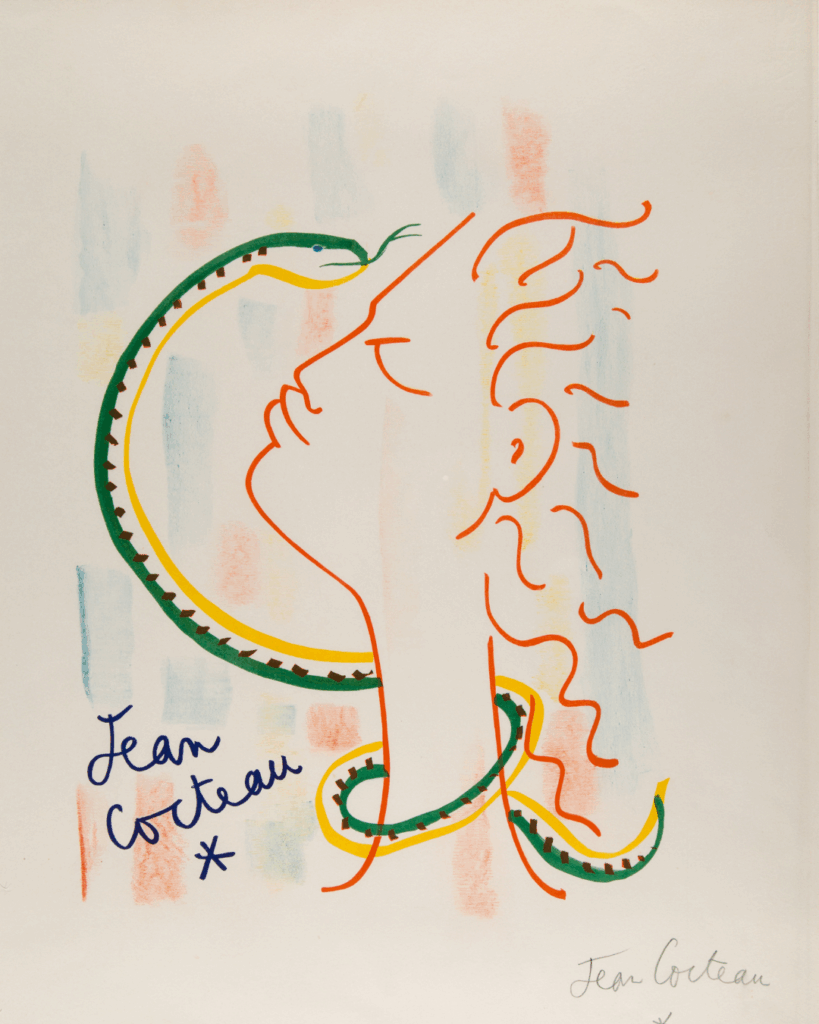
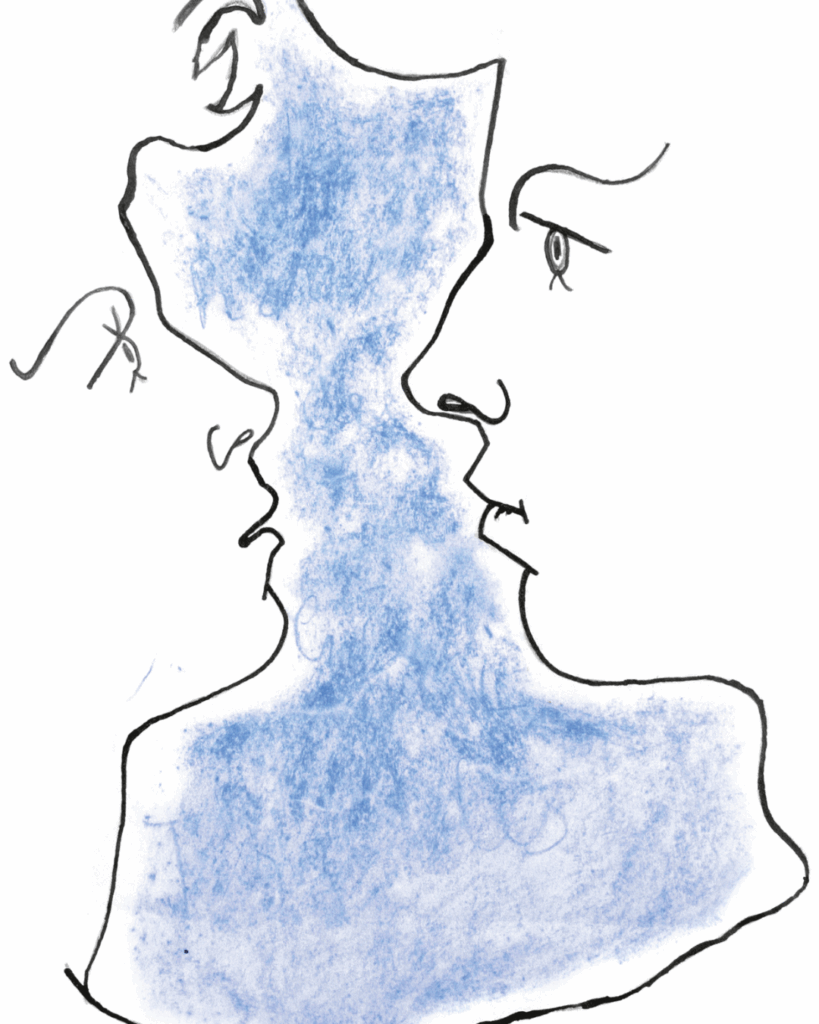
Jean Cocteau, Profil d'orphée, Dessin aux crayons de couleur et feutre; Courtesy from Exhibition at Musée Yves Brayer
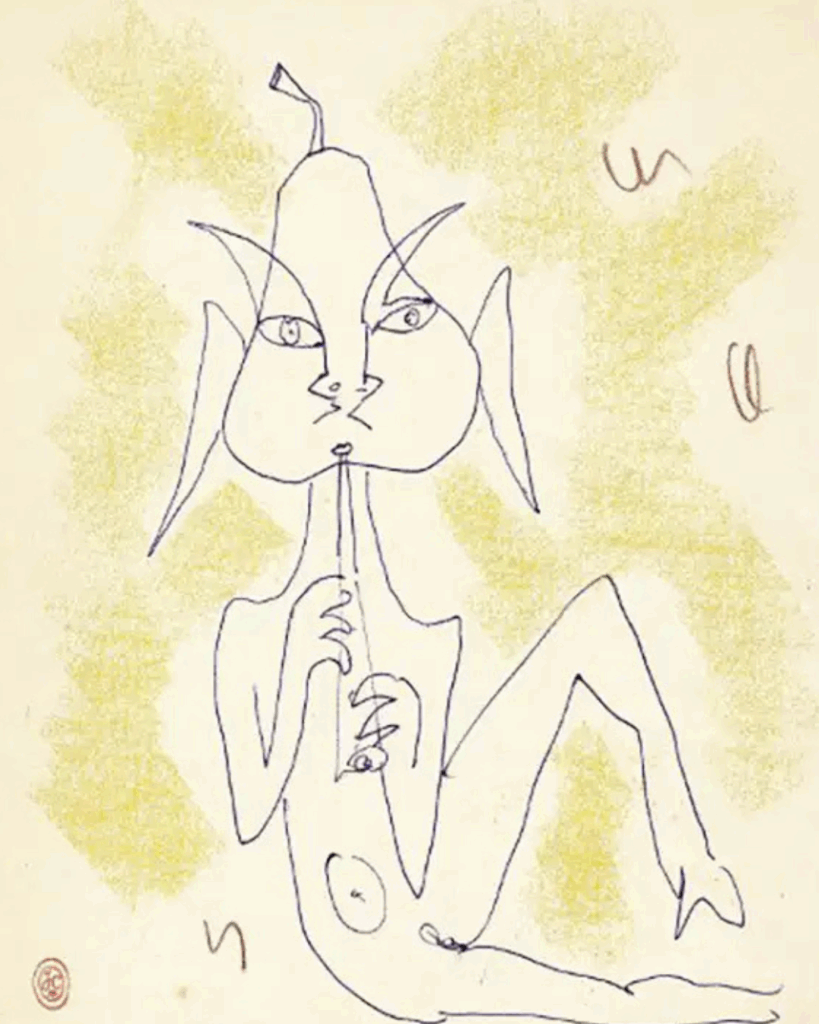
Drawings by Jean Cocteau. Images Courtesy from Exhibition at Musée Yves Brayer
II. PROSE AS A SYSTEM
Cocteau’s prose writing functions as an extension of his theatrical and visual practice. The recurrence of certain motifs — doubles, masks, thresholds — operates not as narrative devices, but as semiotic anchors within a fluid symbolic regime. His texts are structurally fragmentary, but conceptually dense.
La Difficulté d’être (1947) resists the conventions of autobiography, favouring discontinuous entries, aphorisms, and syntactic ruptures. Julia Kristeva, in her psychoanalytic reading of Cocteau, interprets the text as a staging of subjectivity as dispersed, mediated, and fundamentally unstable. Rather than offering a retrospective account of the self, the book performs a continual displacement of the subject through language.
ean Cocteau - Les enfants terribles, 1929, Nicole Stéphane et Edouard Dermit, dessin encre; Courtesy from Exhibition at Musée Yves Brayer
Les Enfants Terribles (1929), perhaps his most canonical prose work, constructs a closed system of ritual, fiction, and code between Paul and Elisabeth. Their enclosed world — the “Room” — becomes a textual chamber where rules of causality are suspended and identity is configured through repetition. Jean-Pierre Richard’s reading foregrounds the novel’s baroque architecture and its tendency toward self-reflexive enclosure. The narrative’s economy, built on internal reference and delayed consequence, aligns closely with Cocteau’s theatrical strategies.
Le Livre Blanc (1928), published anonymously, articulates a luminous phenomenology of desire. Composed as a series of erotic vignettes, the text refrains from polemic or argumentation. Edmund White has described it as “the most translucent defence of homosexual love in French literature.” Its transparency is structural: the narrative voice refuses any distancing commentary, choosing instead to present desire as both contingent and absolute.
III. SACRAL SURFACES AND ICONOGRAPHIC SYNTESIS
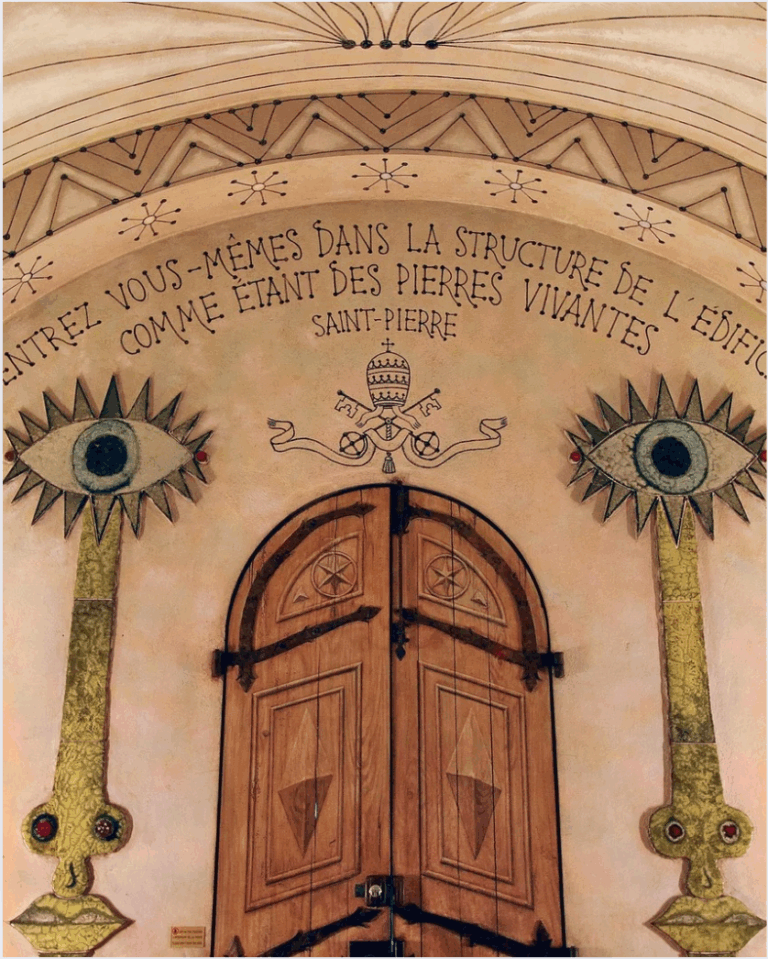
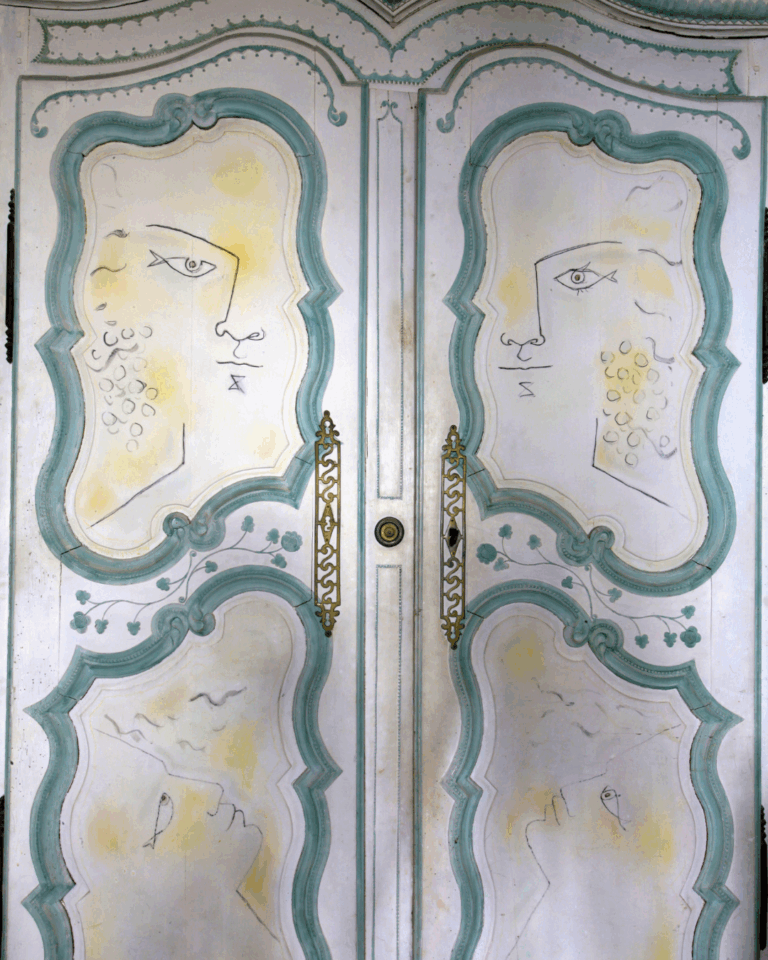
Cocteau’s engagement with religious art in the 1950s marks a critical development in his visual language. His interventions at the Chapelle Saint-Pierre in Villefranche-sur-Mer (1957) and the Chapelle Saint-Blaise-des-Simples in Milly-la-Forêt (1959) constitute a synthesis of drawing, architecture, and iconography. The resulting visual programs are not decorative in nature, but structured around a liturgical sensibility that aligns sacred space with narrative surface.
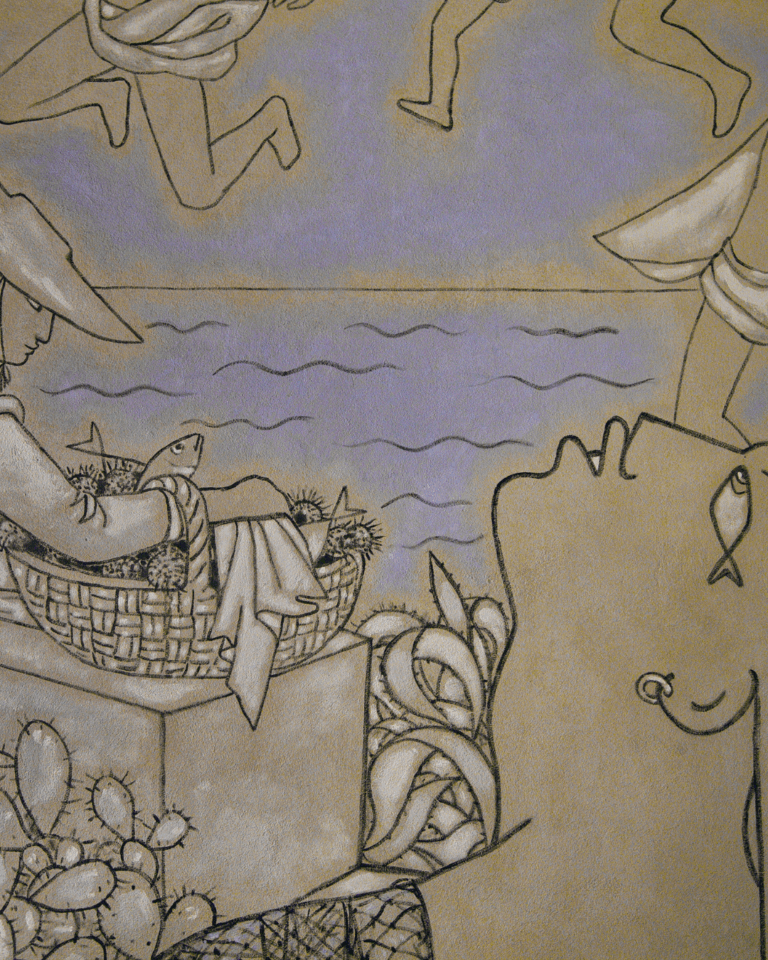
Pierre Caizergues describes Cocteau’s murals as “psychic theatres,” wherein the act of inscription transforms space into a site of symbolic activation. The iconographic vocabulary — fish, saints, zodiac signs, vessels — draws from early Christian and Mediterranean imagery, but is rendered through a graphic immediacy that recalls both children’s drawings and medieval marginalia. The result is a form of sacralised visual writing, legible as both liturgy and diagram. Cocteau referred to these interventions not as frescoes, but as “tatouages,” underscoring their relationship to the body and to ritual marking. The walls do not illustrate doctrine; they record gesture, breath, and symbolic recurrence.
Door To The Chapel Of Saint-Pierre, Patron Saint Of Fishermen, Entirely Decorated By Jean Cocteau In 1956, Villefranche-Sur-Mer, Alpes-Maritimes by Alamy
Mural painting by Jean Cocteau in the Fishermen’s Chapel (Chapelle de Saint-Pierre des Pêcheurs) in Villefranche-sur-Mer, Côte d’Azur, France. By Alamy
IV. FASHION AND THE AESTHETICS OF CONTOUR
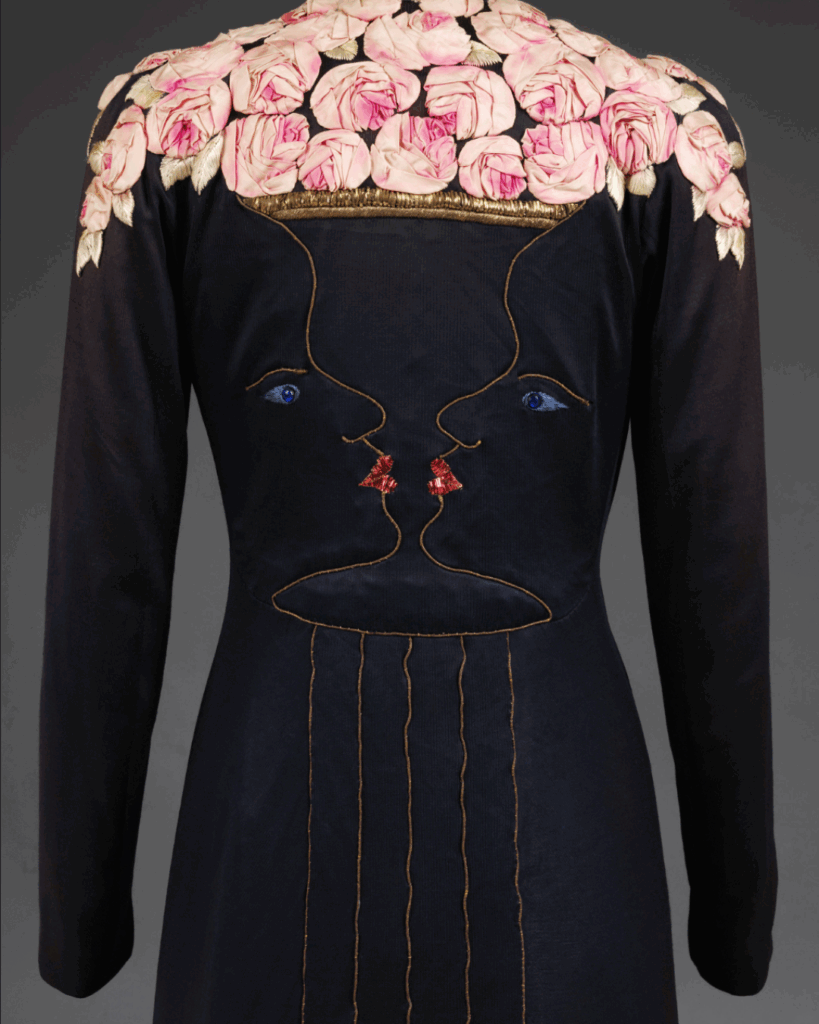
Cocteau’s collaborations with the fashion world — particularly with Coco Chanel and Elsa Schiaparelli — represent a crucial site of intermedial convergence. His contribution to fashion illustration and garment design extended his investigation into the aesthetics of the line, understood here not as ornament, but as signifying contour.
In 1937, Schiaparelli produced a series of garments based on Cocteau’s drawings. These included evening jackets embroidered with stylised female profiles and flowing hair, and a waistcoat designed around the motif of the eye.
Executed by the embroidery house Lesage, these pieces translated Cocteau’s graphic language into textile structure. They do not merely feature his drawings — they operate as extensions of his symbolic vocabulary, displacing figuration into gesture.
Daniel Roseberry’s recent work for Schiaparelli continues this legacy through a process of critical citation. His Haute Couture Autumn–Winter 2025–2026 collection, presented during Paris Couture Week, engages Cocteau’s iconography not through direct quotation, but through formal correspondence. The collection incorporates sculptural silhouettes, surrealist symbols, and anatomical gold appliqués. In this context, Cocteau functions not as historical reference, but as structural precedent — a model for the integration of drawing, body, and abstraction.
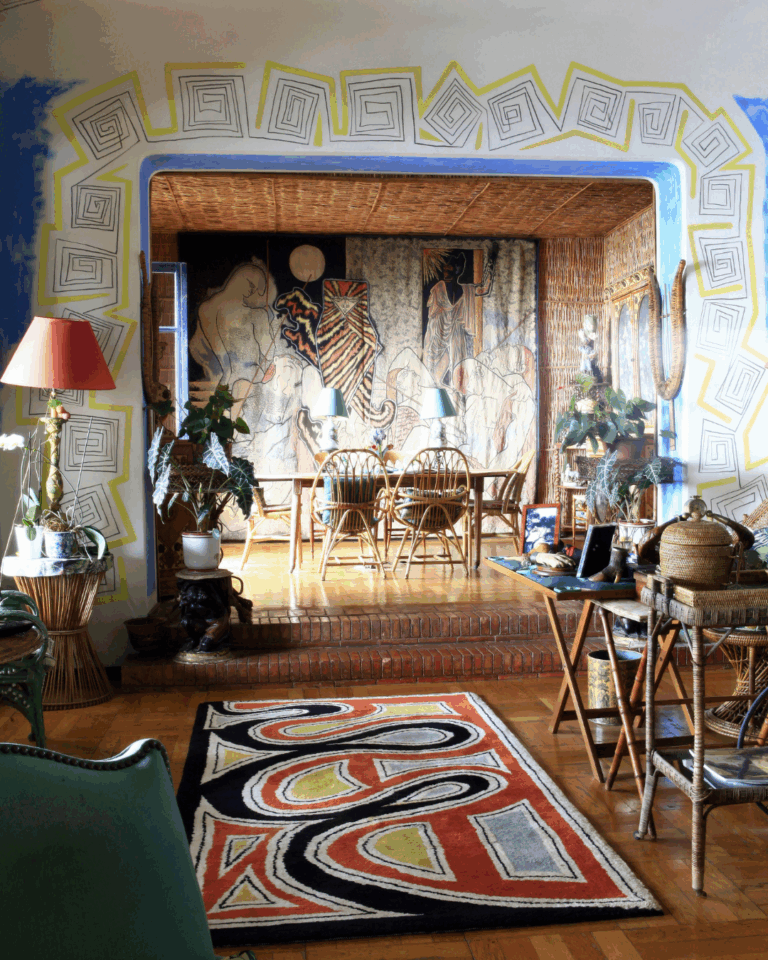
Between 1950 and 1962, Cocteau transformed Villa Santo Sospir in Saint-Jean-Cap-Ferrat into a private site of visual and symbolic experimentation. Rather than decorating the villa, he described his intervention as “tattooing” it — a term that signals both intimacy and irreversibility. The walls, ceilings, and doorways are inscribed with mythological and religious figures: Orpheus, Apollo, Medusa, Christ, centaurs, sirens.
The house becomes a living manuscript, organised not chronologically or thematically, but diagrammatically. The inscriptions respond to the architecture without subjugating it; they function as a continuous score in which each room enacts a different modulation of the same symbolic language. Art historian Annie Guédras defined the villa as “not a house, but a metaphor,” and her reading foregrounds its status as both domestic interior and total artwork (Gesamtkunstwerk).
Santo Sospir thus constitutes the most complete articulation of Cocteau’s intermedial practice — a non-institutional space where line, image, surface, and symbol converge into a single lived aesthetic proposition.
Villa Santo Sospir; By Alamy
Villa Santo Sospir; By Alamy
Jean Cocteau’s œuvre may be read as a topology of forms: a network of transpositions, correspondences, and structural echoes that displaces the primacy of any single medium. Across theatre, prose, sacred mural, fashion, and domestic space, he constructs a system in which symbolic recurrence takes precedence over narrative unity.
His work does not seek closure, coherence, or definition. It proposes a method of visual and textual thinking in which style is generative and form is relational. What remains is not a canon, but a field of transmission.
ORLANDO SUGGESTION:
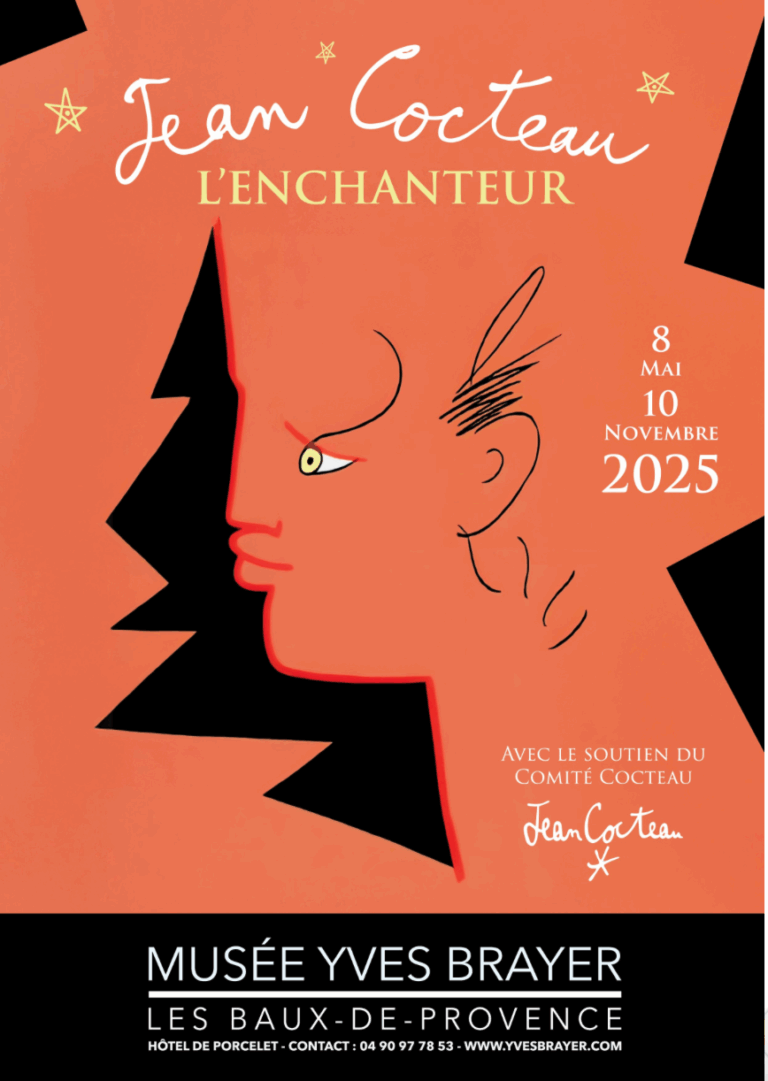
If you’re curious to dive deeper into Cocteau’s universe, the Musée Yves Brayer in Les Baux-de-Provence is hosting an exceptional exhibition until November 11, 2025: JEAN COCTEAU L’ENCHANTEUR. Over 100 original works of the french polymath: drawings, photos, film posters, bring his dreamlike world to life, including a special focus on The Testament of Orpheus, photographed on location by Lucien Clergue.
Our founder sat down with Elisa Seitzinger for an exclusive conversation about tarot, creative and personal time, the Major Arcana, black cats, birth charts, and much more.
In Victorian England, strawberry parties transformed a fleeting fruit into a refined ritual of summer, where the season revealed itself through quiet enchantment and entered literature, painting and social memory.
A Victorian chamber of vision, where painting and poetry meet at the threshold of the invisible, and beauty becomes a language of longing. The visible world begins to glow like a spell whispered between art and the soul.
An insightful and entertaining conversation with the talented Private Chef from the worlds of art and luxury.
By Antonella Dellepiane Pescetto
Are you a sensitive and curious traveler, constantly searching for beauty, art and cultural inspiration? Sign up to receive the latest contemporary news!