

An Enchanting Refuge
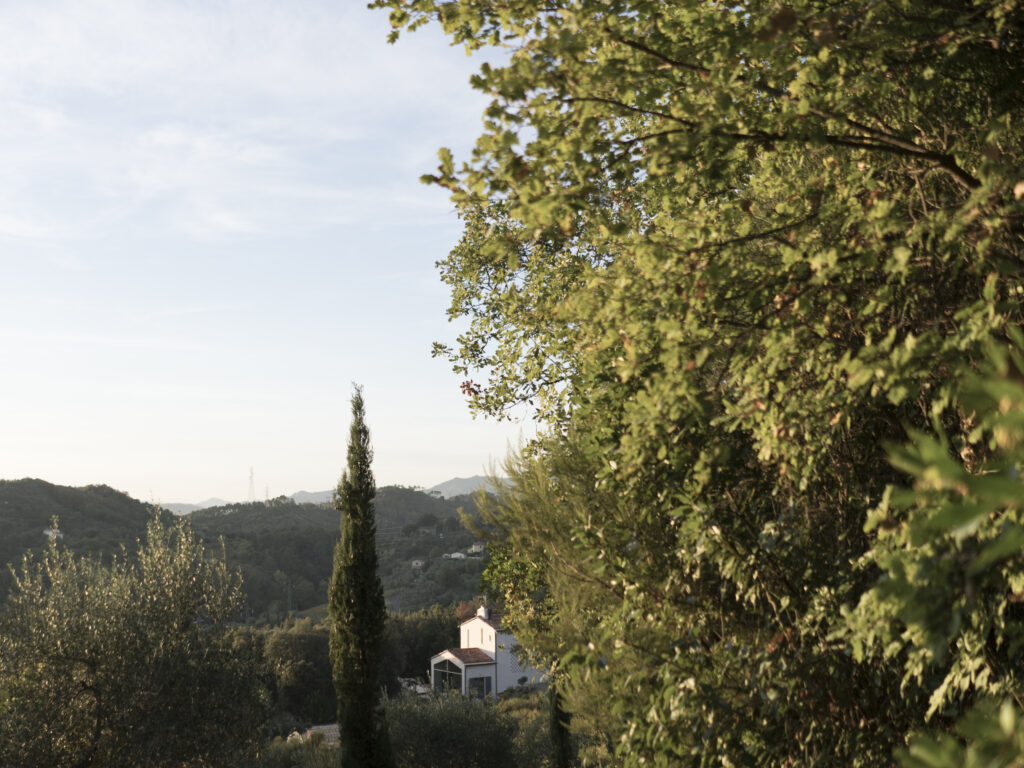
There is an enchanted place in the hills of Sarzana, Liguria (Italy), hidden in a forest of oaks and holm oaks, among aromatic herbs, broom, myrtle, maritime pines and peonies. It often happens in Liguria to discover precious and surprising treasures in unexplored contexts. Liguria is one of Italy’s most secretive regions and one that guards its treasures jealously, like its inhabitants.
La Fustaia is a receptive structure with three spacious suites, where luxury hospitality, immersion in nature and creative inspiration dialogue with each other, creating a dreamy melody, made up of chirping, the whistling of the salty wind in the foliage and the plush step of Muna, the owner’s wonderful Czechoslovakian wolf, who loves to be pampered by guests and taste sweet delicacies.
Fustaia means high forest, whose plants are born from seed and must be cultivated to maturity. What welcomes and envelops guests, thanks to its perfect fusion with nature, is the old hunting lodge of the Lamotte family estate, which includes the aviary in which the Count used to let his birds free; these are the rooms that Lucia Vallesi has cared for, restored, doing an immense job, refined and consistent down to the smallest detail.
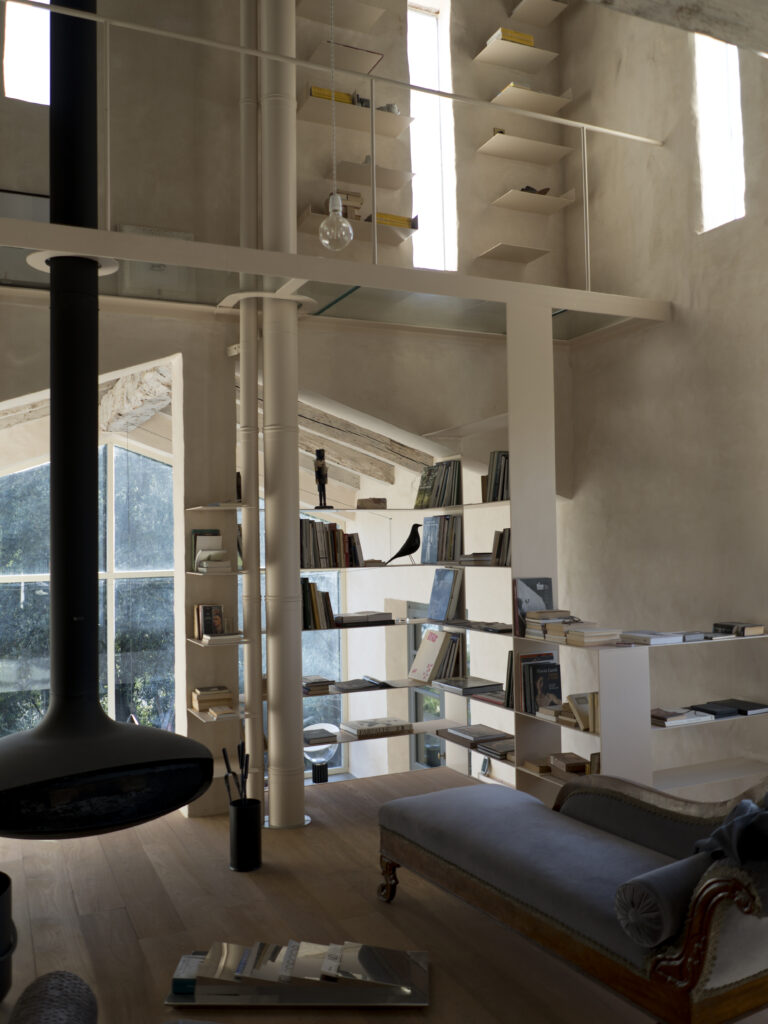
The structure extends over four floors and is traversed by an iron bookcase, a cast-iron stove and a suspended staircase that divide the rooms. If you lift your gaze, you can see the exposed ceiling beams and also the old barn jalousies (the slits that let natural light filter through in a poetic and unusual way).
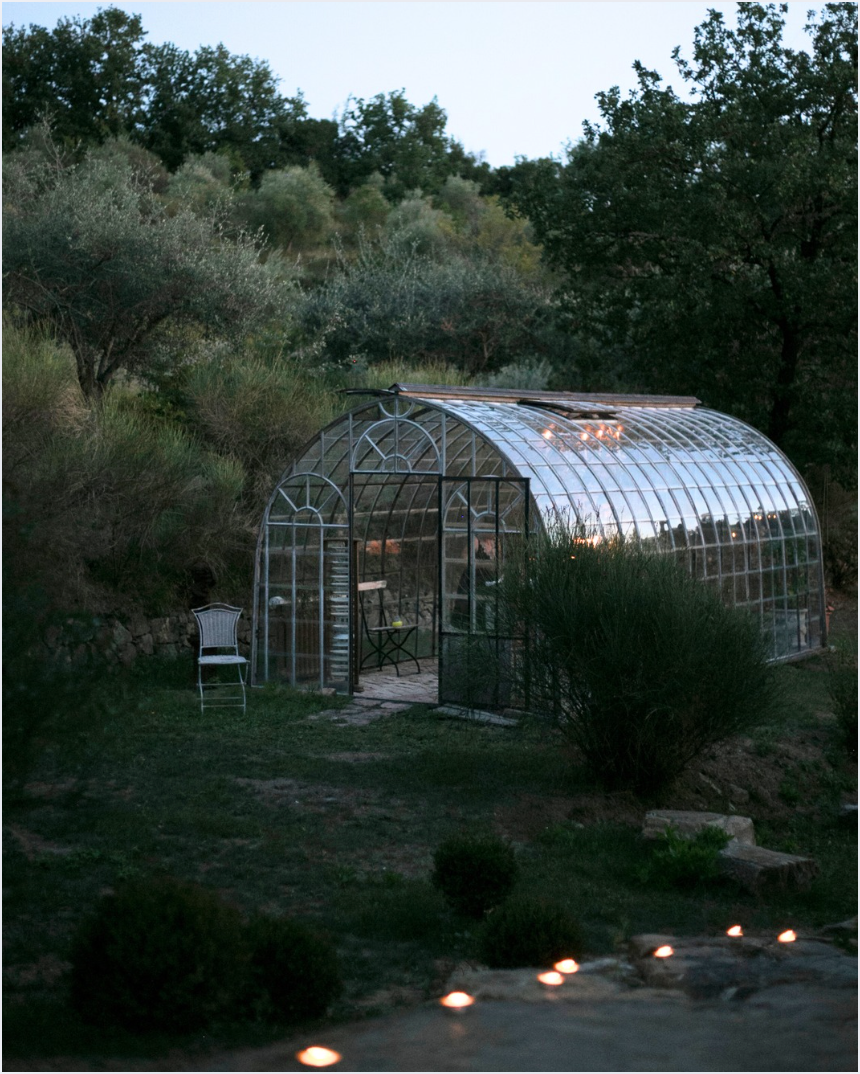
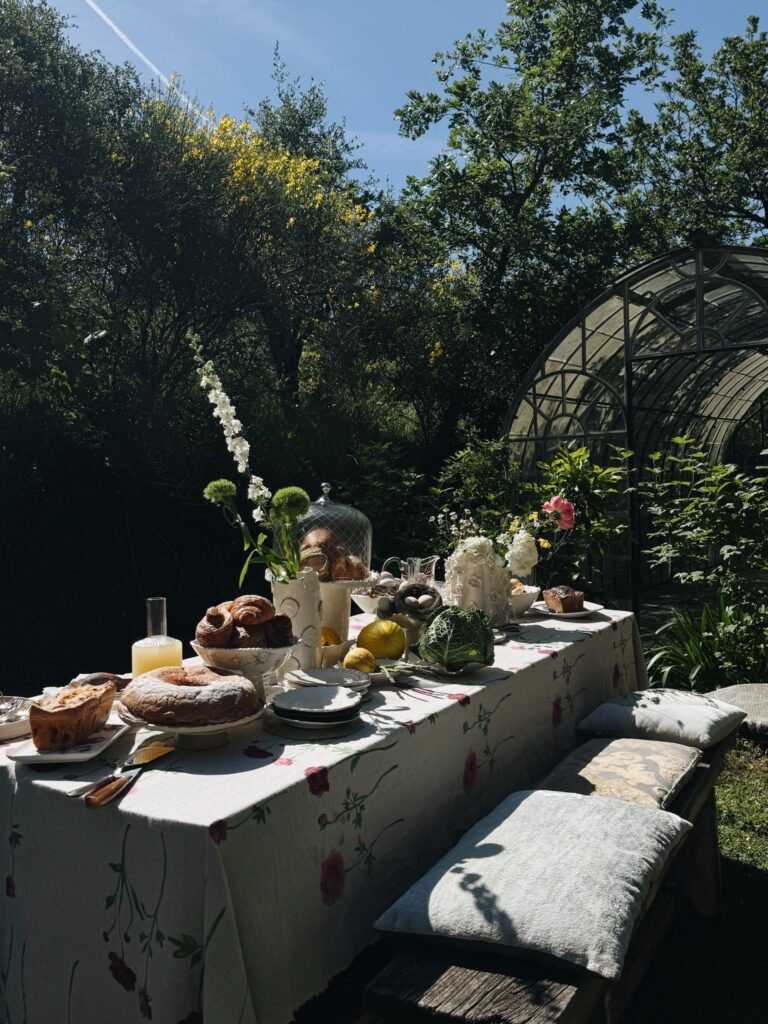
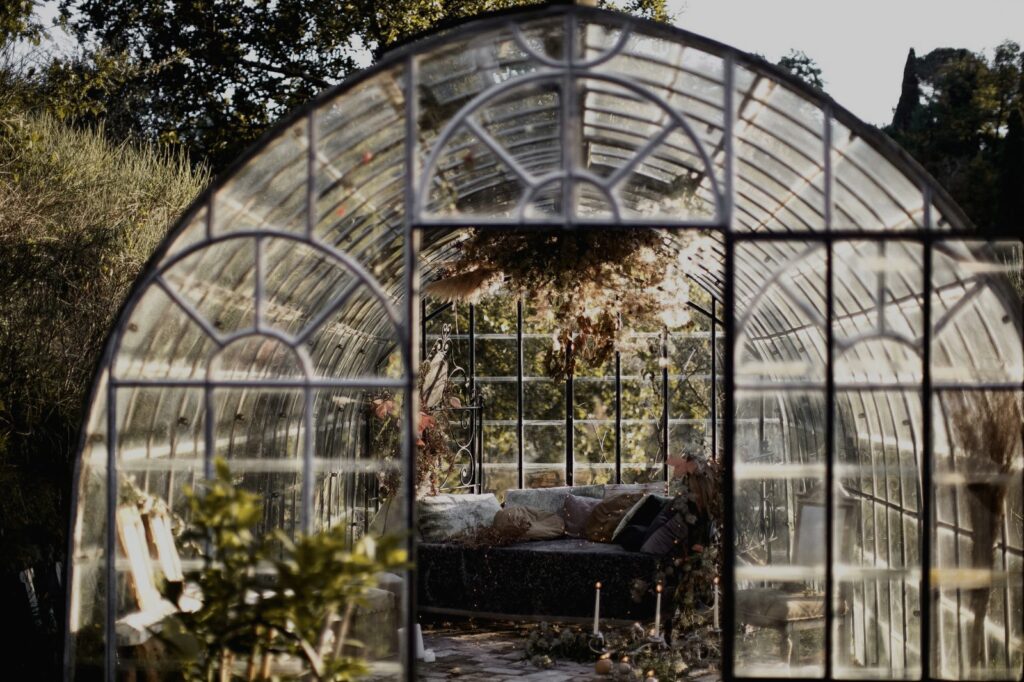
Another detail that struck us is the fact that the roof of the house has been restored with old tiles that belonged to a church and reclaimed wood. The walls are in seven-ply unfired lime and the palette throughout is very soothing and elegant, from cream to deep greys. Ample airiness is given to the structure by the large window overlooking the wood and the original 19th-century greenhouse, where Lucia sets up refined breakfasts with her carefully prepared and cosy mise en place and where she organises creative workshops. The building is enriched by a splendid infinity pool that stands where the cistern used to be.
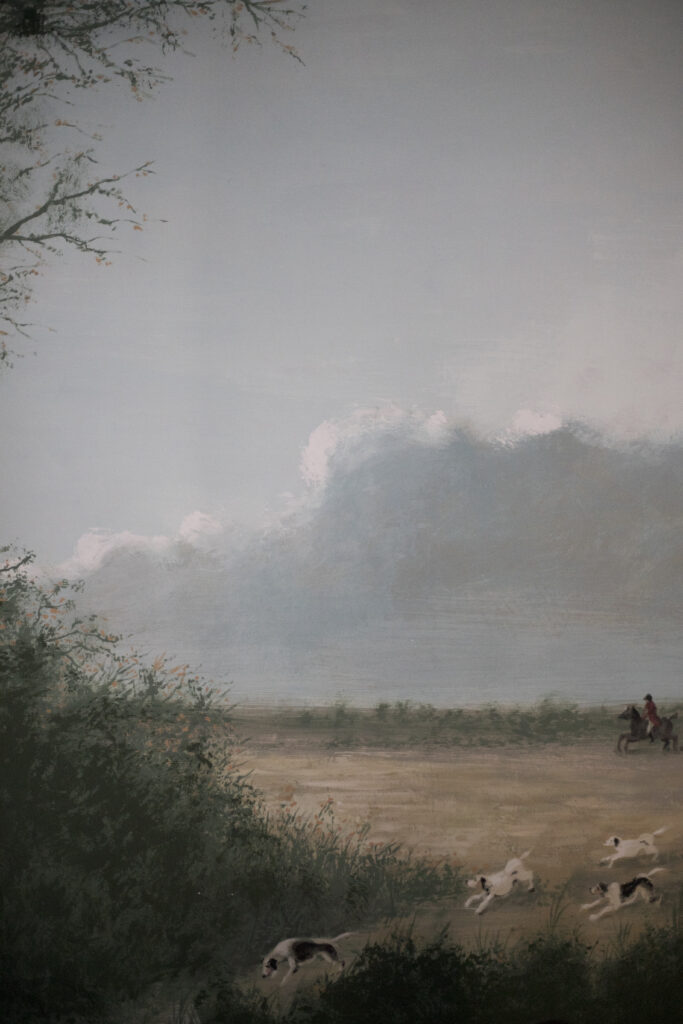
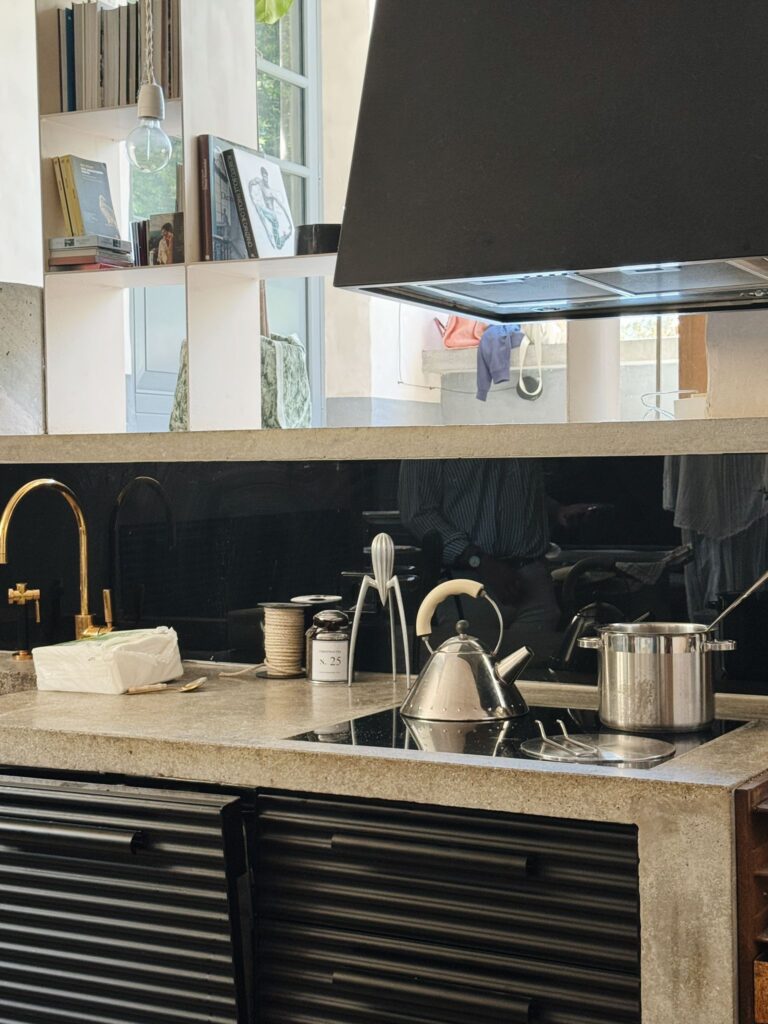
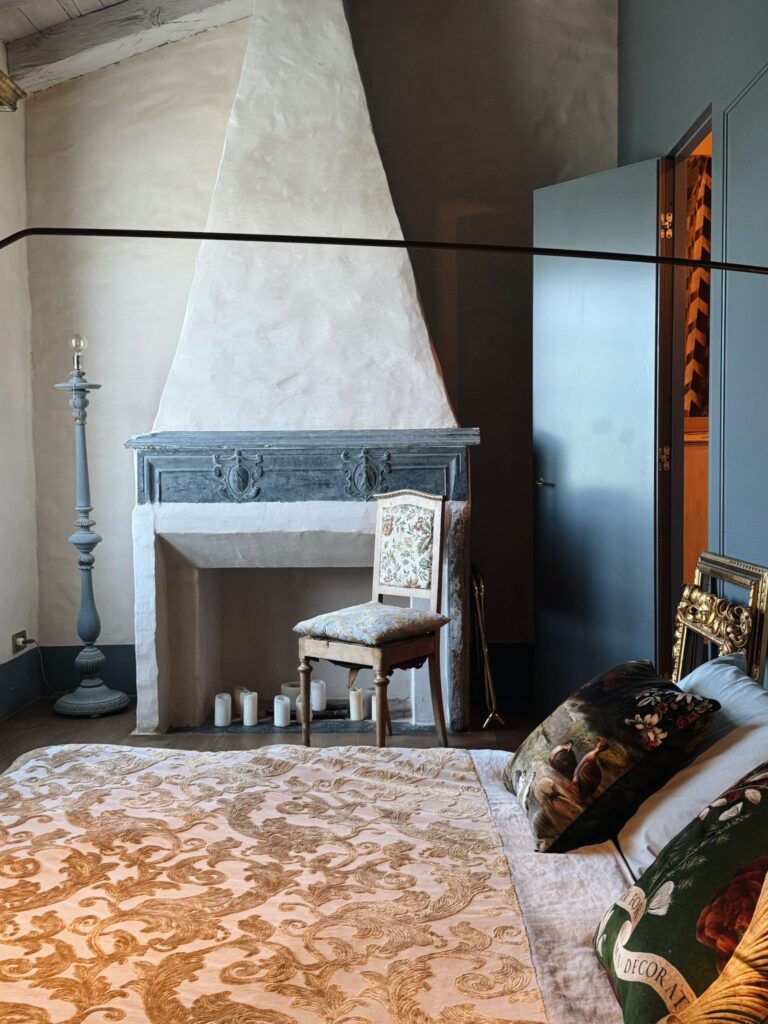
In the interiors there are cosy fireplaces, boiserie French windows, arches, brocantage bathtubs, frescoes on the walls with a nature and hunting theme, Devon&Devon bathrooms, Flos lights in addition to the braided light fixtures, reminiscent of the past. The furnishings are an alternation of antique pieces from the 19th-century estate, such as an old family coat-of-arms, visible on the entrance door, with design pieces such as the Cinque Terre kitchen by Vico Magistretti, with handcrafted pieces created by local artisans, such as the table decorated by Valentina Giovando and the ceramics by Andrea Rovai, with also pieces from the family history, such as a vintage BMW rally motorbike.
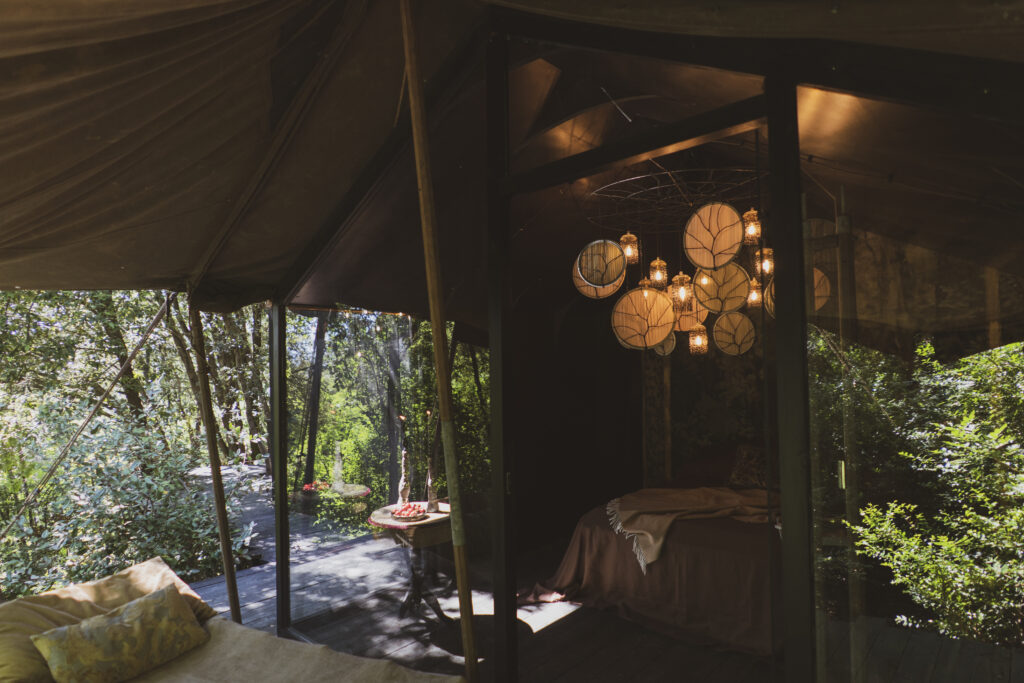
Finally, a novelty, the glamping: a structure recently created by Lucia, a few steps away from the main structure, more immersed in the forest, a real tree house, an American camp tent on stilts, equipped with a white bathtub that completely overlooks the forest in which to regenerate from everyday life. Inside this structure there are other extraordinary details: the black tiles look like buttons and are recycled plastics reminiscent of animal scales or the studs of some particular botanical species; an ancient hand, belonging before to a statue, holds a golden candle near the open-air shower; a dream-catcher chandelier is placed above a bed that has as its headboard, or rather scenic backdrop, a tapestry painted by Elena Carrozzi, depicting a forest scene and a fawn.
Lucia also offers a series of sought-after experiences ranging from creating centrepieces with berries and surrounding natural elements, to horseback rides to the Sarzanello Fortress, contemplating peonies, tasting Vermentino, local wine and walking among the rows of vines.
Lucia also offers a series of sought-after experiences ranging from creating centrepieces with berries and surrounding natural elements, to horseback rides to the Sarzanello Fortress, contemplating peonies, tasting Vermentino, local wine and walking among the rows of vines.
We have the pleasure of engaging with the guardian and protector of this fairytale-like place.
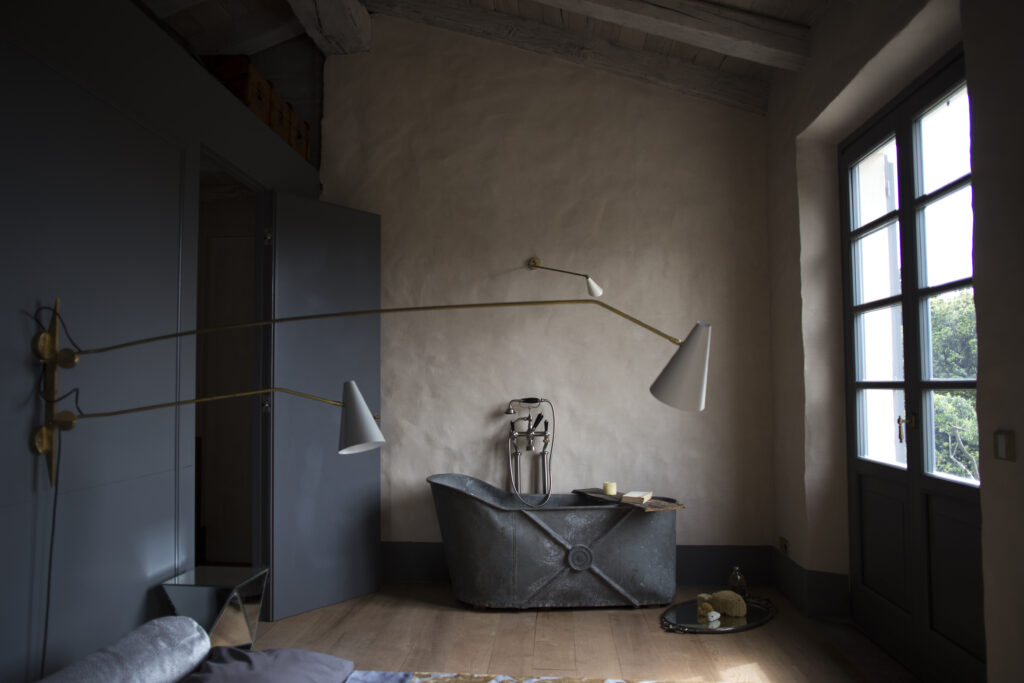
Lucia, you changed your life and left all your certainties behind to throw yourself into the crazy enterprise of completely restoring this house and sharing it with refined visitors and nature lovers. Tell us how this desire was born and how you experienced this gestation?
I studied architecture, I was in my final year and my father passed away suddenly and, although I had no economic need, I felt the responsibility to become independent and leave my studies to work. In hindsight it was a big mistake and I suffered a lot from this choice. As a job I was in charge of budget and order management at ASL (Azienda Sanitaria Locale) and I did that for fifteen years… it certainly gave me stability, but it was a job that neither satisfied nor stimulated me. Then other complex family situations arose, including the separation from my husband, so the uncertainty became even more evident, which led me to the decision to give up all certainties, because I felt this strong creative urge and I had to express it.
I think I have completed my architectural studies, in a way, although not academically, but thanks to this restoration, which lasted about eight years.
I started by researching the farmhouses in the area to understand how they had managed the restoration, together with my architect, then there was the phase of building permits, which was complex, because the farmhouse was registered as an aviary and so we had to take an agronomic route, for which I had to take exams and get certificates.
Then we started the restoration, the search for materials and workers to do this kind of work, and in the meantime I sold some of my properties.
The place was completely overhauled, there was no access road, no main pipelines: it was a forest! But when I arrived at the top of the road leading to the aviary, I felt a call: a very strong desire to shape the place.
What was the most beautiful part of the restoration and what was the hardest?
The thing that gave me the most satisfaction was the stained glass window: it was my architect’s idea. An idea that I had initially rejected, because I was very tired in terms of permits, but when she reassured me that no further permits were needed, then I was thrilled. That intervention was decisive because the outside goes inside the house. The perception of the actual size of the glazing I had on site when I saw it under construction, inside the warehouse, also because it is a whole side of the house. It is also very beautiful in winter, in the solitude when it rains, it is like a waterfall and I read or study, in this concrete bench. The most challenging part of the renovation was definitely the roof. It was dilapidated and I did not know how to blend it with the rest. I went a little crazy because I bought the roof of a restored church, I had to call an engineer working on Venice, who gave me a whole book of certifications, to make the roof pass the structural exam. It was hollowed out by hand and filled with iron and, at the end of this whole procedure, as the wood had been healed and restored, I repointed it with raw lime as it was originally…I wanted to give the same elegance that was already present in this place, the feeling I had when I entered this dilapidated ruin.
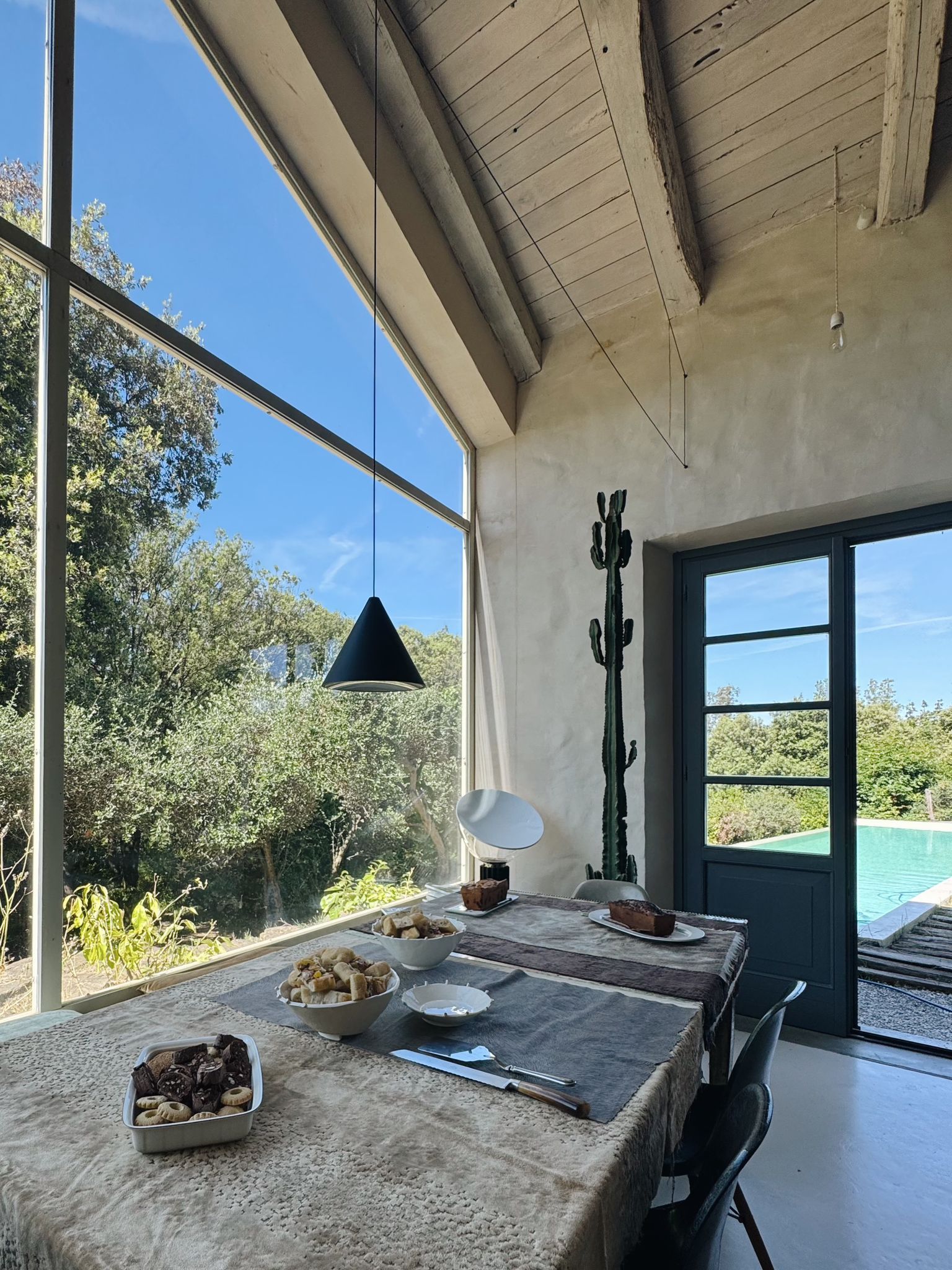
Did you immediately choose the type of palette and furniture or did you have other options in mind? Was there any element that was key in influencing your choice of other furnishings?
I immediately had the idea, because I followed the pre-existing colours. I then interfaced with my daughter Costanza, who went the academy of fine arts, studying scenography, and she cleared my mind, indicating three basic colours. I stayed with these colours and tried to decorate the place a little; I liked the lines of the walls to play the main role.
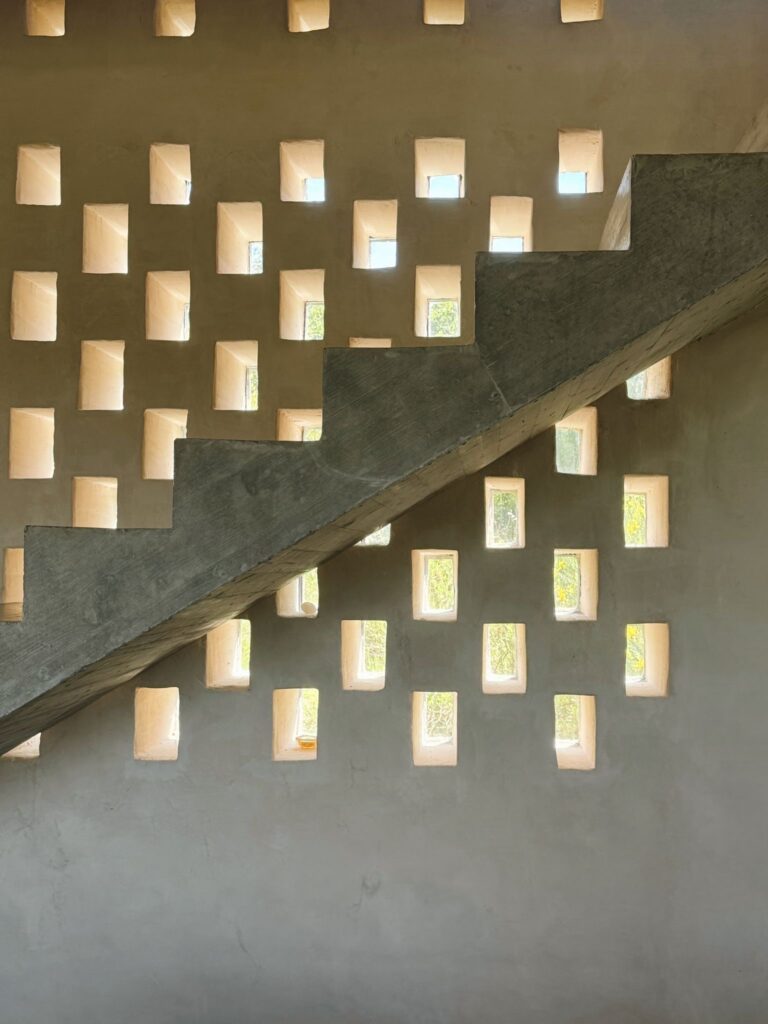
There was also a complex study behind the new interventions, such as the reinforced concrete staircase that crosses the structure of the house and marks the various staggered levels; the inside of the staircase is made of river stones and Carrara marble that form these cracks in the walls, which are emphasised at night.
I had a lot of furniture, because I changed four houses, my mum’s house.
I kept some furniture that was part of my husband’s family’s aristocratic villa, such as a late 19th-century secretaire, made of wood and Carrara marble with 9 secrets (drawers, which usually are 7) and a dormeuse, on which dogs used to sleep in the late 19th century, and I combined them with modern, design furniture, such as the Flos lamps, the Focus fireplace, the kitchen (Magistretti’s Cinque Terre), etc..
Then an even more studied choice to dialogue with nature and the environment was the decoration of the glamping: I spent a lot of time on this, because I wanted to do a recycling job, to create a shelter, to open up a search for something contextualised.
The lamps recall the habitat, they look like vines that you touch and they light up, the towel rails are suspended, the bathroom lights look like reeds.
Tell us about the first guest who had the pleasure of staying overnight at the Fustaia.
I didn’t immediately realise the potential of communication: the right description and image immediately appealed to the kind of person I was hoping for. The first guests were a classical music composer from New York and a singer with her French producer. These types of guests were what I wanted to achieve with this type of venue, and they are also what enriches me. I was afraid that the guests would then be different from the initial ones and far from my expectations, but instead, fortunately, they continued on this trend. This place gives not only the aesthetic beauty but also the agrarian context, the greenery, the silence, the energy recovery, the refuge.
From your guest’s feedback what strikes them most about the Fustaia and what has given you the most joy over the years of hospitality?
The most frequent feedback has been that arriving at the Fustaia is even more beautiful than expected and what one perceives from the pictures.My type of welcome, my reading of poems during breakfast and my care of the place have been much appreciated.
How did the glamping come about?
Actually, the idea was born in the early days, along with the project, maybe even before the house. I had the idea of creating several glamping sites in our space, having visited Provence a lot…the French are much more gypsy than we are. Then came the fashion of glamping: a combination of glamour and camping, which is part of my way of life and how I renovated the house. This country chic really appealed to me as an idea.. In Italy it came much later. After renovating the house, I have also recently finished the creation of one glamping, designed down to the smallest detail to blend in with nature; it is exclusive, only for the couple that manages to get there.
From an artistic point of view, what has characterised your path?
Since I was a child, I painted very well and my parents were called by the school to direct me towards an art high school, but they prevented me from attending, because, in the past, the art high school was different from today. My daughter then took that course of study, without me forcing her in that direction; she took on what were my passions: ballet, the art high school, everything I had inside and which I transferred to her. I have always loved fashion, design, the combination of colours, and then the other artistic aspect I followed was definitely architecture: whenever we travelled and, with my husband, for work, we did it often, my attention was directed towards the architecture of the houses that changed in different contexts, in different countries. Unconsciously, as I travelled, I observed every place, through every little detail, from the b&b to the luxury hotel.
I paid a lot of attention to the mise en place and everything related to breakfast. In France, I used to see wicker baskets with cheeses, in Germany there were many charcuterie, in every place I found something that enriched me… then I also felt this desire to observe handicrafts, after having done a shoot related to cooking, made by Sale e Pepe, a cooking magazine that my mother used to buy. I started to discover local artisans, as there is an academy of fine arts here that encourages these crafts. From then on, I started mixing artisanal dishes with fine family china. Every day, at La Fustaia, I change flowers on the table because of the need to create this picture, painted through objects.
You have already set artistic performances at the Fustaia, transported by its charge of inspiration and magic. Can you tell us some of them?
I have set a number of artistic performances at the Fustaia, but the one that most moved me was the one performed by some dancers who were influenced by the place; they played two birds of the forest, getting dirty with earth. It was exciting, I felt it was mine and naturally generated by this place.
You can feel it perfectly when you come here, on site, but would you tell our readers what kind of experience it is to stay a few nights at the Fustaia?
The experience is that of completely detaching yourself from the city. Not that the place has no noises, but the noises are just those of nature, which change during the seasons. People tell me that they sleep very deeply when they stay overnight, perhaps also because the place is very oxygenated. When guests arrive, in the evening, from the restaurant by the sea and walk up the hill, in a place that is very dimly lit, deliberately, at this time of year, they find a spectacle of fireflies to welcome them, they enter into a magic. In the morning, the chirping of many birds and if you take a walk, you may come across a roe deer. All these primordial experiences regenerate you. When there is wind, the forest sings. You are in an elegant setting, with all the comforts, but with an ancestral contact.
What does hospitality mean to you and what is your way of living here and conversing with your guests?
I have always imagined and dreamt of it as a place where the guest arrives and internalises a feeling that will remain over time. My idea of hospitality is that it permeates people’s minds and bodies, a memory that stays with them. It is not a place where you stay, sleep, and have breakfast, but a place that goes beyond that. This is what I want to give, what I hope to give.
You have sown precious, emotional, familiar, personal details in every part of the house and guests can walk a path to discover these smallest details of craftsmanship, materials and design. What are your favourite details of the Fustaia?
I would like the guests to notice the details. Sometimes they ask me to describe individual pieces, but really it is the whole that should give you the fusion and the emotion. I like to surround myself with books, I would like people to look at them and leaf through them to take their minds far away. The bookcase gives the sense of the 4 floors of the house: it divides the spaces and makes them communicate.
In the structure I really like the directional slits that enclose the light and it seems to me something ingenious made by farmers. These slits were used to receive the sun from where it rises to where it sets, and they directed the heat and light into the part used as a hayloft to dry the hay.
In addition to these slits, I also really love the Bugie, those openings in the wall, there are 92 of them, which had the function of airing; they let in light in a special way.
I sleep on the loft and my body and mind initially needed darkness, to sleep, then I completely adjusted to the rhythms of light.
Do you use a particular playlist to welcome your guests?
I have to say that I change it all the time… I really like classical music or even new singer-songwriters who use different modes of interpretation, or jazz. When I see young people I always ask for advice, because they are my source of inspiration.
If you found another place that fascinated you as much as this one. Would you be willing to start all over again and embark on a new restoration adventure?
This is my creature and I would find it very hard to tear myself away from it, but in life never say never. It’s a place that requires a lot of energy, but things change from one day to the next so you can’t say it’s not possible.
I think I’d go back to the place where I was born, Tellaro, which is part of the Gulf of Poets, I’d go to a fisherman’s house, small stacked where I’d have to make a big effort as an old woman to climb the stairs. I would do a restoration of this kind.
Another idea I have in my mind is to live here, at La Fustaia, almost as a hermit, surrounded by dogs. And, a recurring dream is that of someone giving me a garden as a present, and who knows what I could achieve then.
Our founder sat down with Elisa Seitzinger for an exclusive conversation about tarot, creative and personal time, the Major Arcana, black cats, birth charts, and much more.

In Victorian England, strawberry parties transformed a fleeting fruit into a refined ritual of summer, where the season revealed itself through quiet enchantment and entered literature, painting and social memory.
A Victorian chamber of vision, where painting and poetry meet at the threshold of the invisible, and beauty becomes a language of longing. The visible world begins to glow like a spell whispered between art and the soul.
Reading leaves us with something: a sharpened awareness, an intuition, a lesson learned without direct cost.
Bringing together playfulness, memory, and materiality through Ceramics.
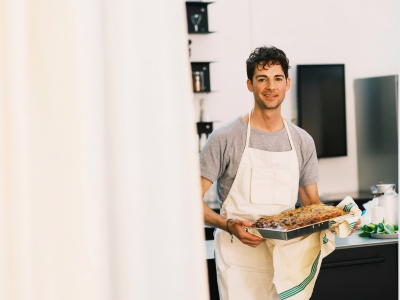
An insightful and entertaining conversation with the talented Private Chef from the worlds of art and luxury.
Are you a sensitive and curious traveler, constantly searching for beauty, art and cultural inspiration? Sign up to receive the latest contemporary news!