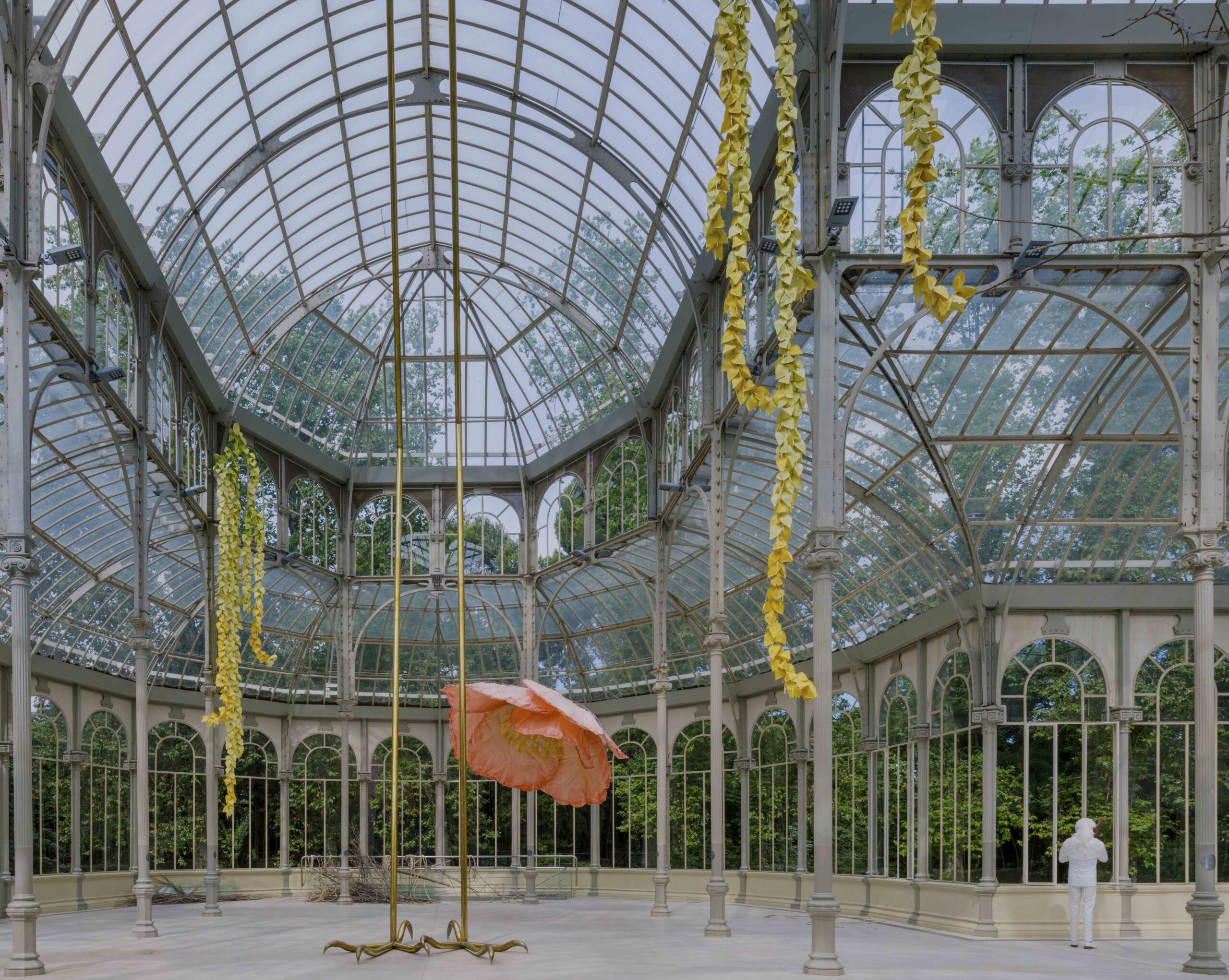
There is something very fine and reassuring in the works of Petrit Halilaj until, that is, certain ambiguous or openly tragic details are noticed. This, of course, is not always true but it is the case of his latest exhibition currently being presented on the roof of the MET in New York. A house that is about to fall in upon itself, a threatening spider (as witnessed in the Abeter installation in New York) or a house going up in flames in the midst of colourful and dream-like figures of birds in flight (as seen in the installation inside the International Red Cross and Red Crescent Museum in Geneva in 2023).
Born in Kosovo in 1986, at the age of 12 he became a refugee, along with his family, during the Balkan Wars brought about by Milosevic. The men were imprisoned, and the rest of the family set of on foot for a refugee camp in Albania. These were such huge events and were bound to cause repercussions in the mind of a young child. Through the works of Petrit Halilaj, we are looking at the world and we are observing both its beauty and its tragic nature. Halilaj creates imaginary spaces which are imperfect at times, yet still managing to be safe havens. There’s the house burning down but there are also plenty of flowers and colourful birds suspended above us in the sky. Indeed, in an interview with Vogue, on the occasion of his latest installation, Abeter, in New York, the artist declared: “Art has always been the saviour of my life. It has always been an escape route and a window for my imagination, enabling me to dream and tell stories”.
Halilaj has always loved to draw and when he was in the refugee camp he encountered an Italian psychologist, Giacomo Poli, who had brought with him paper and felt-tip pens. He asked all the refugee children to depict the atrocities that they had lived through as well as the natural scenes that comforted them, since it was only through sharing the experience of trauma that their collective healing would begin. Halilaj did 38 drawings: half of them were birds in idyllic settings and the other half were houses burning to the ground with tanks and soldiers bearing blood-stained weapons. Dr Poli departed the camp, but they soon started writing to each other and one day his family welcomed Halilaj, 17 at the time, into their home so that he could attend the Brera Academy in Milan.
His first important exhibition was at the Berlin Biennale in 2010 and since then, by taking part in all of the world’s most famed art events as well as exhibiting his works in museums around the globe, Halilaj has become one of the most interesting artistic figures in contemporary art and has managed to transform real life into an art form. No way is it imitation. It’s his story and the story of our society. It is an individual emotional experience which, translated into art, turns out to be something that is wholly universal, bringing with it powerful messages. Halilaj’s works are a blend of dream and reality, of childhood and adulthood, of disapproval and hope, of astonishment and awareness, of trauma and healing. They investigate our histories and ourselves. They delve into our pasts and bring to the light our desires, just like in the most beautiful adolescent fantasies.